
Dear Planning Planet Members,
Welcome to the newsletter; did you know that this newsletter goes to the largest community of project controllers on planet Earth? As many of you know we’ve transitioned to a new, faster, and more modern web portal that’s already benefiting our users. We appreciate your ongoing feedback in identifying the bugs or issues we need to fix.
Written something on project controls—an article, a thought piece, or even a rough idea? Get in touch and we’ll include it in future posts. It’s free, and we love collaborating with our community.
GO WITH TECHNICAL OR EMOTION OR BOTH?
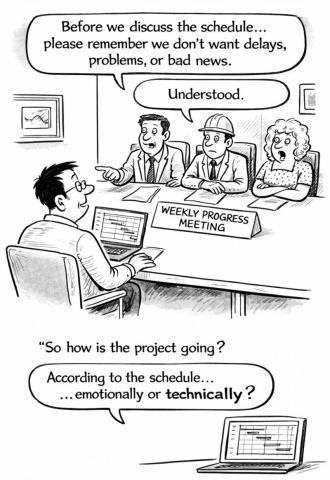
How to Be a Great Planner Without Emotional Intelligence
Very simple.
Just follow these proven steps.
- Start every conversation with progress
- Immediately challenge the number
- Use the schedule as a weapon
- Ignore reality
- Always escalate
Of course in real projects the schedule is not only about logic!
It is about people under pressure trying to deliver something difficult.
And that’s exactly where emotional intelligence becomes one of the most important skills a planner can have.
Curious to hear your experience...
Source: Dariusz Wołejszo, DBA, MBA, MSc
How often do schedule discussions become emotional discussions on your projects?
THE NEXT PHASE OF PROJECT CONTROLS WILL NOT BE ANOTHER DASHBOARD!?
The next phase of project management will not be another dashboard. For decades the industry has been trying to improve reporting.
- Better charts.
- Better KPIs.
- Better risk models.
All useful.
But none of them change the underlying reality:
- The execution plan itself still isn’t intelligent.
- It sits there like a static artifact while humans try to interpret it, adjust it, and coordinate around it.
- That’s about to change.
- We’re entering a phase where AI will operate inside the execution logic of the plan, not just around the paperwork.
Instead of asking software questions like: “Show me the critical path.”
We’ll start asking things like:
- What sequence actually gets this finished fastest?
- Which resource conflicts will emerge next week?
- What are the three best recovery options if this slips?
- What trade-off shortens the project without increasing risk?
And the system will reason through the plan itself.
Not by reading reports.
By understanding the structure of execution.
But the real shift is not automation.
It’s collaboration. Right?
Source: Alan Uren
VALUE-ADD and FREE WEBINARS

March 18: BI-GanttView - Effective Gantt Charts in PowerBI
The Emerald BI-GanttView is a visual tool for Power BI that was created to fill the existing gap that we saw in Power BI’s Gantt chart offerings. This tool offers extremely configurable charts, with multiple columns, three-layer timelines, improved label control, top axis milestones, multiple hierarchy levels for a full WBS hierarchy display, and more. Just about everything is configurable, including the shapes and colours of your milestones, font styles and sizes, color coding of activity bars, robust sorting capabilities, increased label control, and much more. You can even display multiple projects, with the information presented clearly for non-scheduling team members.
March 26: CAPPS v14 - Primavera P6 Updating
Not all of your project team members are P6 EPPM experts. That’s where Emerald’s CAPPS (Capital Projects Progressing System) comes in, giving your team a simpler way to work with Primavera P6 schedules, find their tasks, and provide timely updates. In this latest version of CAPPS v14, we have improved the usability of filters and layouts to make updating task and baseline input and approving these updates much easier. The inclusion of a crosstab grid for lightning fast updating will allow your team to get updates in daily instead of weekly and even monthly. With more frequent updates, your team will have better visibility into project progress.
April 1: OPC-Integrator - Easy Updates in Oracle Primavera Cloud
Emerald has created the OPC-Integrator to make the setup of Oracle Primavera Cloud (OPC) and the project data entry process less time-consuming. This flexible and secure tool simplifies OPC data extraction, loading, updating, and integration with third party tools like SAP or Oracle Fusion. Users can import and export many of the key data elements available in OPC, allowing for the movement of data back and forth between OPC and Microsoft Excel in a smooth and controlled manner.
LET'S OPEN UP OPPORTUNITIES TOGETHER

To support every practitioner, employer, consultant, and recruiter in our network, we’re now opening up free job postings for everyone. Whether you’re:
- An employer with a vacancy
- A regular practitioner looking to strengthen your team
- A consultant searching for standout talent
- A recruiter with a role to fill
…you’re invited to share your opportunities with the entire Planning Planet community. We pledge to keep this free of charge for job posters and applicants throughout 2026. Simply contact [email protected] and we’ll help you get your role in front of thousands of committed project controls professionals.
Let’s make this a space where opportunities flow freely, careers grow, and our community continues to lift one another. View Jobs... Post Jobs...
Senior Planner – Power & Energy (Southwest Dublin, Ireland)
- Permanent Employment Ireland (EU.IE) €85,000–€90,000 + €7,000 car allowance + benefits
Cumbria – Contract Site Planner (Civils, Freelance)
- Contract Employment Cumbria (EU.UK.CMA) £500/day + accommodation
Planners (Nuclear & Power)
- Permanent Employment United Kingdom (EU.UK) £75,000 – £90,000 + car or allowance (circa £6,500) + staff benefits
Amsterdam – Lead Planner (Data Centres)
- Contract or Permanent Netherlands (EU.NL) €100,000 + car/allowance (circa €7,500) or competitive freelance rate
Dublin – Lead & Senior Planners (Hospitals / Civils)
- Contract or Permanent Ireland (EU.IE) €70,000 – €95,000 + car or allowance (circa €7,500) + staff benefits
London – Lead Planner (Main Contractor, Permanent)
- Permanent Employment London (EU.UK.LON) £85,000 + car or allowance (circa £6,500) + excellent staff benefits
Senior Claims Expert
- Permanent Employment UK-North West (Region) Negotiable, Heathcare
Senior Planner
- Contract Employment Warwickshire (EU.UK.WAR) £690 per day
Planning Claims Analyst
- Permanent Employment Surrey (EU.UK.SRY) Initial salary £65,000 to £76,000
PROJECT CONTROL (COST, SCHEDULE, SCOPE) - HOW MUCH IS REAL?
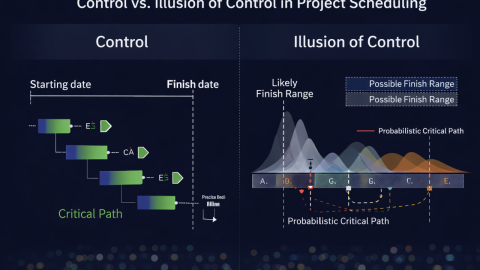
In project management we constantly speak about control: control of schedule, control of cost, control of scope. Yet in complex projects an uncomfortable question emerges: how much of that control is real, and how much of it is simply a feeling of control?
For decades, deterministic schedules—based on fixed durations and single critical paths—have offered a structured and reassuring view of projects. The apparent precision of these models makes them extremely attractive for organizations.
But that precision can hide something deeper: the simplification of the uncertainty that actually governs project behavior.
Researchers such as Mario Vanhoucke and Öncü HAZIR have shown how traditional planning models often present a mathematical precision that does not fully reflect the real variability of projects. When that happens, what appears to be control can become something more subtle: the illusion of control.
Paradoxically, in an era dominated by data, simulation, and advanced analytics, organizations still show a strong institutional preference for exact dates.
Probability ranges create discomfort. Probabilistic estimates are harder to accept.
Perhaps because probabilities live in an uncomfortable middle ground: they offer neither absolute certainty nor complete ignorance.
Neither perfectly certain nor completely uncertain.
Perhaps that is why we continue to plan inherently uncertain systems using models that promise a level of precision the real world rarely provides.
The article explores this tension and reflects on an essential distinction: the difference between controlling a project and understanding how it may behave.
Read the article, have your say....
Source: Jair Aguado Quintero. I.E, MBA, PM4R®, SpS.
CAPABILITIES AND LIMITATIONS OF MICROSOFT PROJECT and PRIMAVERA P6
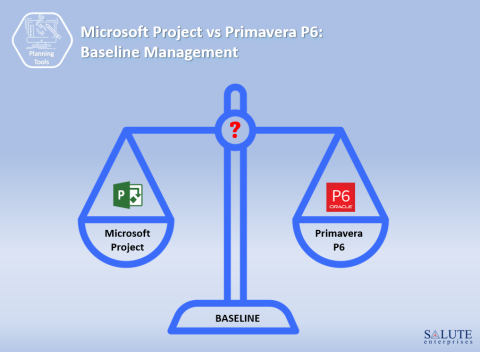
This is a series of posts that will help to dispel myths, understand the capabilities and limitations of Microsoft Project and Primavera P6, and reveal the real, bias-free differences.
Baselines are handled differently in both systems. Each has its own advantages and gaps. Some capability gaps are common for both systems. Neither provides full capabilities for governing nor analysing baselines. Because provided baseline capabilities and gaps may or may not be critical to a particular program/portfolio, it is hard to say which system is better. There is room for improvement in both systems.
Covering topics such as below, it will surely be one to follow...
- Baseline management
- Baseline Analysis
- Schedule comparison capability is a major topic worth a separate post.
- Capturing Baselines
- Project Baseline Limitations
- Schedules updates
- Schedules without baselines
- Baseline visualisation on the Gantt chart
- Baseline Assurance
Source: Alex Lyaschenko
DISTRIBUTION CHOICE SHAPES YOUR P90
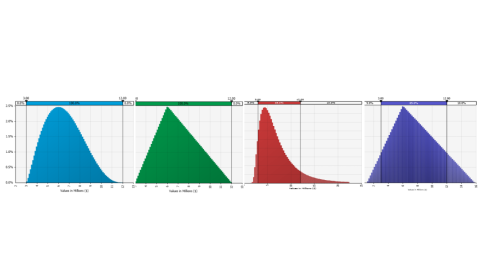
“Use PERT” and “Triangular is conservative” sound helpful, until you see what they do to exposure on big ticket risks.
In project risk modelling we debate inputs all day, Best Case (BC), Most Likely (ML), Worst Case (WC) scenarios, correlations, durations. But we often treat the distribution as a default. That is where credibility quietly leaks.
This article explores modelling uncertainty based on how risks actually behave in complex projects, rather than forcing everything into familiar templates.
This article is my attempt to reset the conversation:
- Not “which distribution is best?”
- But “what does this choice imply about uncertainty, and can I defend that implication for this risk, at this stage of the project?”
Source: Amin Jalili
SCHEDULE PLANNING and DEVELOPMENT PROCESS: A STEP-BY-STEP GUIDE

What are the significant processes in developing a schedule and the processes for controlling a schedule?
The planning and development of a schedule are the key components that play a vital role, ensuring that projects are executed with utmost efficiency, risks are mitigated, and stakeholders enjoy complete transparency on timelines and progress.
Schedule development cycle is based on standard Plan-Do-Check-Act (PDCA) methodology to ensure scheduling is not a one-time set up but actually a continuous improvement exercise through the course of a project.
This article breaks down:
- The step-by-step process of creating and developing your schedule.
- Role of each phase i.e. Plan, Do, Check, Act contribution in project control.
- A practical example of why each & every step is important in a construction project.
Source: Kareem Khattab, Planning Manager
THE TEAM NEEDED A CLEAR WAY TO DIAGNOSE WHAT WAS DRIVING NEGATIVE FLOAT

Does this sound familiar?
As the project progressed, unforeseen delays driven by procurement challenges and external dependencies threatened a critical milestone.
The team needed a clear way to diagnose what was driving negative float, validate sequencing assumptions, and identify feasible options to accelerate work without inflating costs or straining field teams...
Even minor adjustments to a project schedule can create ripple effects, especially on complex builds where milestones are tightly linked.
That was the challenge facing Suffolk Construction as the team led preconstruction and construction planning for a life sciences development where schedule certainty was critical to success.
When external factors put key dates at risk, the team needed a clear way to diagnose what was driving negative float, validate sequencing assumptions, and identify feasible options to accelerate work without inflating costs or straining field teams.
By leveraging ALICE’s Schedule Insights Agent, the team identified optimal ways to re-sequence work and improve productivity, ultimately recovering 42 days in the schedule.
Read the full case study here....
ADDING A LOGO TO YOUR ASTA PRINTOUT
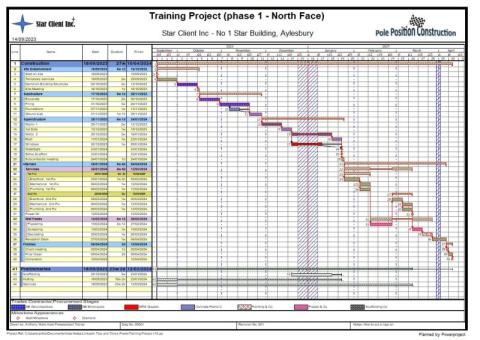
Adding a logo to your border - Recap
Go to File, Print and select the ‘Print Options’ button, on the dialogue box that pops up click on the ‘Details’ tab. If you don’t have an existing company border then I recommend one of the standard supplied borders which you can find by clicking the drop down arrow under ‘Border file’ and choosing one of the borders that begins CHT then the paper size A4/A3/A2/A1 then L for landscape or P for Portrait, for my example I have chosen CHTA3L.b Now click on the Edit button which will launch Powerdraw the border creation software which comes with Asta Powerproject.
To add a logo in Powerdraw, click on the mountain range looking button at the top of the screen ‘New Picture’, then place your cursor where you want your logo to go and click drag a box to the size you want your logo, let go and another dialogue box will pop up, click Filename and browse to your logo location, when you have chosen your logo click 'Open', you will now see a thumb nail of the logo, you can now click 'OK' on the dialogue box. Repeat for any more logo’s you would like on the print out. Finally go to File, Save As, and give your border a name, save and close Powerdraw. Now go back to...
Source: Anthony Ward
IMPROVE CONTRACTOR COORDINATION, EXECUTION VISIBILITY & TURNAROUND PLANNING CONTROL

Improve contractor coordination, execution visibility, and turnaround planning control — all within one governed platform:
iPlanSTO supports unlimited users — including maintenance contractors, vendors, and specialist service providers — all operating within a shared turnaround dataset.
This ensures all stakeholders work from the same scope, plans, materials, and execution status without requiring expansion of ERP user licenses or granting contractors direct access to systems such as SAP.
Outcome: Improved cross-organisation communication, reduced data duplication, and fully aligned shutdown execution teams operating within a controlled digital environment.
Contractor Feedback:
- The reporting we have allowed us to identify issues at a Supervisor, Work Centre, Work Location, Discipline Level.
- By funnelling all work through iPlan everyone is able to see the work assigned to them, the status of said work and whether we’re getting through the backlog.
- Site Management have a holistic view of what is in process enabling decisions to be made on labour, materials etc.
First look at iPlan4.0 AI-Enhanced Planning: WATCH VIDEO— or VIEW BROCHURE. How would this transform planning in your world?
Are you based in Texas or Louisiana? If so, the IAMTech team will be there in person during March and July and are offering a limited number of in-person and online demonstrations of iPlan4.0.
To arrange your demonstration, contact [email protected].
UNDERSTANDING THE CONSTRUCTION PROJECT LIFECYCLE: From Owner Requirements to Operation & Maintenance
A construction project progresses through a defined lifespan involving three primary stakeholders: the Owner, the Architect/Engineer, and the Constructor. The figure illustrates the progression of a project from the owner's initial requirements to its long-term operation and maintenance.
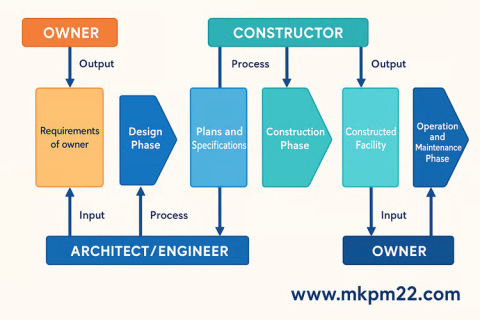
This page elucidates each phase utilizing scholarly references and professional construction literature.
Sections include:
- Key Stakeholders in the Construction Lifecycle
- Lifecycle Phases
- Why the Sequence Matters
- Practical Takeaways
- Conclusion
- References
The full post can be accessed here: Understanding the Construction Project Lifecycle
WHAT IS PROJECT and PORTFOLIO MANAGEMENT

By combining effective project oversight with strategic portfolio alignment, organizations can successfully manage and guide all different projects, optimize internal resource management, and make better and more informed decisions. This is where Portfolio Management comes into play...
Table of Contents
- What is portfolio and project management?
- The difference between project management and portfolio management
- Why portfolio and project management matters for organizations
- Project portfolio management in practice
- Benefits of portfolio and project management
- Best Practices for Successful Portfolio and Project Management
- Portfolio and project management software from Cleopatra Enterprise
BLOG NO 5 - CONTINUING WITH PEOPLE – PROJECT CULTURE
Fed up with adverts from software companies and consultancies that are going to change the world of Planning and solve all your project problems? This series of occasional articles promises nothing but thought provoking questions on how well we understand the basics of our profession from the perspective of a retired planner with 50 years’ experience in the industry whose worked in a variety of UK EPC roles for Clients and Contractors with no axe to grind.
We are going to look at PEOPLE, PROCESSES, and PROCEDURES (the old 3P’s – not 4P’s, 5P’s, 6P’s or 7 P’s) that we all have been educated and trained to use in our everyday work (5W’s + 1H) and POKE THEM IN THE EYE / LOOK UNDER THE STONE (the Inverse Universe) and get into trouble with the planning profession because for loads of reasons were not doing so well. If you want to contribute to this soul searching drop me a line with either POSITIVE or NEGATIVE comments (yes, we are PLANNERS that can hold both views at the same time!)
Continuing with PEOPLE No 6 – Guest Author - Diane Bragoni
For my last blog on PEOPLE, I have invited Diane to say a few words (as that is what planners do). Whilst they have their own views on most subjects, they fully appreciate that a different perspective can sometimes resonate with the team. Like a lot of planners Diane works in a specialised area which requires specific subject area knowledge which can often be at odds with mainstream thinking. Whether it is military, high-rise, oil & gas, process, railways, infrastructure, datacentres, pharmaceuticals, nuclear, STO’s etc we all have our own planning language, standards, drivers, and reasons WHY WE WORK IN PLANNING. For Diane it is the people she serves.
How a Concrete Sidewalk Changed My Career
I didn't grow up dreaming about construction schedules. I studied engineering as an undergrad, then went on to get my graduate degree in architecture. Scheduling wasn't something anyone talked about in school. I didn't even know it was a career path.
Then came 2010.
I was early in my career, living on a military installation with my family, and managing a construction project. A contractor came to me with a change order - a concrete sidewalk issue in front of the building. Their ask was straightforward: $10,000 and five extra days. Seemed reasonable. I brought it to my boss feeling pretty confident.
He looked at me and asked, "Does it affect the critical path of the schedule?"
I had no idea what that meant.
He explained it to me. If the change touched the critical path, we'd owe the contractor $5,000 for every single day they were delayed past their completion date. That $10,000 change order could quietly become $35,000.
That moment stopped me pretty quick. Not because of the money, but because I realized how much I didn't know, and how much it mattered.
As I took on more projects, the potential daily delay costs grew. $10,000 a day. $50,000 a day. $100,000 a day. Sometimes more. But what kept driving me wasn't the dollar figures.
It was the people.
I lived on those installations. So did my husband, his colleagues, our neighbors, and their kids. These were families making enormous sacrifices - spouses separated for over a year during deployments, parents missing milestones, kids growing up without one of their parents nearby. If I could do anything (even something small) to help projects finish on time and support that community, I was all in.
That one question from my boss set the course for my entire career. I went on to earn my RA, PSP, PMI-SP, and PMP, and eventually founded CPM Schedule Solutions LLC, where we provide schedule, cost, and risk services for government and owner's representatives, including the DoD with USACE, NAVFAC, and the VA.
And it all started with a concrete sidewalk that, by the way, did not affect the critical path. We paid the contractor their $10,000 and moved on.
So, I'd love to hear from you - how did you get into construction scheduling? Was there a moment, a mentor, or a project that opened the door for you? I'd love to hear your story. Send me a note at [email protected].
Respectfully,
Diane Bragoni, RA, PSP, PMI-SP, PMP
Founder & Principal Consultant
For my next blog (No 7) I am moving on to PROCESSES and taking a look at underlying problems with our basic tools and techniques that we all have to use, starting with time, calendars and dates/times, the basis of all our work. If there are any PEOPLE subjects you think we have missed let me know and I will pick them up in a later blog,
OFF-SHORE CLIENT CASE STUDY

IAMTech Offshore Client iPlan4.0 Case Study: Built on nearly 30 years of turnaround delivery experience, iPlan4.0 embeds proven shutdown and turnaround best-practice methodology directly into the application — guiding teams to plan the right work, to the right standard, at the right time. The result is a step-change in planning data quality, driving safer, more predictable execution and dramatically increasing the likelihood of plants returning to service on — or ahead of — schedule, protecting production revenue and corporate reputation.
Discover what this meant for one of our offshore clients: View Case Study.
SUPERIOR ALTERNATIVE TO THE "MOST POPULAR" SOFTWARE FOR US AS PLANNERS?

A superior alternative to the "most popular" software for us as planners?
Spider Project Team is a group of project management consulting and training companies. With headquarters in Moscow, Russia, we have branches, partners and representatives in other Russian cities, Australia, Brazil, Colombia, Kazakhstan, Romania, USA. We develop professional PM software Spider Project that is the most powerful and functional tool for project, program, and portfolio management.

We develop advanced approaches and methods of project management that are widely used by our customers in 37 countries. We provide training on project management and Spider Project software for our customers around the world.
We manage projects for our customers and implement corporate project management systems in companies of different industries. We believe that good project management can improve our world and are happy to provide the best services and tools to our customers.
We are proud of our achievements. The current version is used in 37 countries. Spider Project offers numerous unique functional features and is the only PM software that optimizes resource, cost, and material constrained schedules and budgets for projects and portfolios.
Spider Project offers numerous unique functional features and is the only PM software that optimizes resource, cost, and material constrained schedules and budgets for projects and portfolios.
Check it out here... Ask questions here...
ARE OFFSHORE OPERATORS LEAVING VALUE ON THE TABLE?

IAMTech Knowledge: Gulf Coast operators are front-loading maintenance. Most will leave value on the table. The region is entering one of its largest Q1 maintenance cycles in years. The operators who execute consistently will pull ahead. The ones who don’t will wonder why. Read full article.
IDNTIFYING DELAYED ACTIVITIES IN PRIMAVERA P6
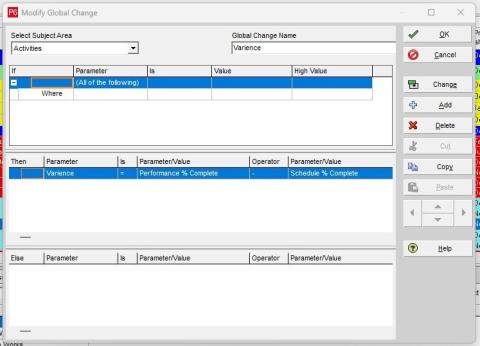
A simple way to track schedule performance in Primavera P6 is by identifying activities that deviate from the approved baseline using Global Change and filtering.
1. Variance Date
Create a Global Change with:
Variance Date = Actual Finish – Baseline Finish
This measures the delay in days compared to the baseline.
2. Variance %
Create another Global Change:
Variance % = Performance % Complete – Schedule % Complete
This shows the difference between planned and actual progress.
3. Apply a Filter
Display activities where:
• Variance Date > 0
or
• Variance % < 0
This quickly highlights delayed activities and supports delay analysis and performance reporting. Join the conversation...
Source: Adham Mohammed
THE BEST CONTROLS CONFERENCE TIL EVA 34

The best controls conference til EVA 34
Back as 2 days we focus on the host of inputs required to inform the Controls and Skills behavioural ,technical ,psychological, and cultural people need to make it happen with purpose.
The full programme is on Eventbrite now...
25% Faithful discount til end April 9 when we celebrate the birth of one of our greatest achiEVers.
Use BRUNEL4EVA
Real Value for Real Content for a Real conference
A few spaces for supporting this and improving your professional network are available.
Source: Steve Wake
WOULD YOU LIKE TO ADVERTISE ON PLANNING PLANET?
We want to give more of our members the opportunity to advertise on our site. Click here to get started!
THANK YOU FOR READING OUR MESSAGES
If you’d like to lend a hand to the small but enthusiastic team behind this newsletter, feel free to reach out to us at [email protected]. We know there’s still a lot of work ahead to make this an informative and eagerly anticipated bi-weekly read, so get in touch and be part of the journey.
Regards...
The Planning Planet Team