Does this mean these the software can level consumable resources, or they just make a warning of some over allocation?
Oracle Primavera P6:
- Adding Resources - Use this task to add resources to the resource pool. Resources include the personnel and equipment that perform work on activities across all projects. Resources are generally reused between activities and/or projects. Resources can be distinguished as either labor, material, or nonlabor. Labor and nonlabor resources are always time-based, and material resources, such as consumable items, use a unit of measure you can specify.
Asta Powerproject:
- http://catalystusa.com/wp-content/docs/WP-2011-Allocating%20Resources%20for%20Construction.pdf
- We use resources to allocate materials. We can also use materials in this way to track stock levels. To do this we use a different type of resource called ‘Consumable Resources’. They are allocated the same way as other resources but have slightly different properties.
Deltek Open Plan:
- http://www.fplotnick.com/CPMinConstructionManagement/DeltekOpenPlanManuals/DeltekOpenPlan35UserGuide.pdf
- Consumable – An individual resource that can be consumed or “used up” over the course of a project. Building materials such as bricks used in a construction project are a typical example of a consumable resource. Units of consumable resources that are not required during one period of availability are carried forward to the next period. For example, assume that the availability of bricks is defined as 3,000 units on a particular day. If the requirement for the bricks is only 2,000 units on that day, Open Plan carries forward the remaining 1,000 units to the next day.
To figure it out we can try resource leveling the following consumable resource scenario [Bricks/Cement&Sand] that is unfeasible unless all are leveled or constrained.




As Vladimir said before – “Manpower shall be leveled but it does not mean that the best solution minimizes idle time of all trades. Fast execution of the critical activities minimizes project duration and indirect costs. Additional indirect costs may be higher than the cost of resource idle time. Resource optimization has constraints like certain target dates and criterion (usually overall project cost). So an approach that minimizes resource idle time does not always lead to the best solution”.
Say delivery 2 is delayed 3 days then what is best action to prevent delays?
Under such delivery schedule better allow for more than 2 bricklayers [16h/day], if availability is increased to 4 this will allow for more than 2 activities to be scheduled at the same time.
https://www.mediafire.com/file/5yj45a11jsygvhs/Activity_Gantt_-_ResourcesA1.2_%5B3%5D_-_Brick_Walls.pdf/file
Johanness solution is overloaded, easy to verify if calculating materials/day and keep cumulative values to calculate inventory levels - please click following link for a PDF you can download.
Or take a look at the following worksheet.
Worksheet calculations
IMHO, The difference between Engineering, Construction and Project Controls (Planning and Scheduling in particular), is never understood until today. WHY? Simply because the process is always forgotten. For example: Engineering has "Basic Engineering" and "Detailed Engineering"; and going forward to "Construction Operations", you still need to develop the so-called "Shop Drawings" and "Method Statements" (which are basically part of detailed engineering). Now, let me ask everyone: How do you usually develop a certain "Construction Schedule"? Or where do you base your "construction schedule" from. Perhaps 99.99% of you will say: You just copied your schedules from previous projects or you were just given samples of similar projects from peers. Now, still wondering why your schedules are always wrong or never followed by people in the fields? The fact is: To develop a detailed construction schedule (material resources included - of course without even mentioning leveling) is only a DREAM! Most of the time, the only thing a scheduler can do is make a guess or assumption. So what do you think would be the output using a software (and resource leveling for that matter)? Kindly check your bins please?
I'm not sure why you had a debate on "consumable materials" (bricks installation in particular), while keep on giving wrong or misleading examples. This is the problem with "sample only", considering theory. It always lead you to believe that what you are doing is correct. However, when the time you come to realize it (or hindsight), you might start to believe that what you did was totally incorrect. As "bricks installations" are not just bricks and mortars. Of course you will need scaffoldings, crane if you are working on high rise, rebars where necessary, stiffiner columns or beams, portable mixer for mortar if manually mixing, or ready mix supply, etc.,etc.,etc. Please remember that theories are always different from realities. Or nothing is certain in real world. So again, Forget about using "Retained Logic Only"!
Among the many things that make-up a good schedule is that it can model how a good PM would schedule the activities, this applies to consumable resources as well.
In many scenarios materials shall be installed as soon as possible no matter if the activity becomes intermittent.
In some cases it makes no sense to wait until all activity materials are delivered; in desperate situations, and in not so desperate, looting might happens, better install the bricks ASAP.
In the case of St. Martin, after the hurricane I do not believe an islander would be so foolish as not to install every single brick, piece of wood or many other materials ASAP. On the other hand some activities such as cement plaster shall be scheduled to be continuous in most instances.
An islander would install bricks ASAP, he will never wait for the activity to be continuous.
Financial constraints are a type of consumable resource that must be leveled in order to avoid disruption of your portfolio. Cash flow is unknown before resource leveling; a good model shall calculate cash flow based on how activity moves, incomes (supply) as well as expenses (consumptions) are not fixed with time. Not all cost components represent cash flow, it is essentially a cost center compose of several cost components.
The model shall be able to replicate real world scenarios. For example activities create the need to rent a piece of equipment as well as its release, they define the rental period as activities move. This piece of equipment pays rent no matter if idle or not during the rental period, but when in use it will consume some materials that have some costs. The resource leveling shall consider all consumable, renewable and financial resources as they happen.
ORIGINAL CHALLENGE - It is just 3 Brick installation activities, 2 cement plaster activities, 4 delivery activities, 3 consumable resources (bricks, cement & sand) and 1 renewable resource (bricklayers) with an availability of 3 assigned in different quantity to the installation activities.
SOLUTION:
Best Regards,
Rafael
Hi Johanness,
I do not understand your remark about the tone of our discussion.
I did not understand your method and suggested to show its application on the simple schedule that you created with minimal change of initial data (4000 bricks per first two weeks and 7000 on the last week instead of 5000 each week).
What is wrong with my request?
To all,
Because Johannes never posted the XER file where multiple activities rolled up it is obvious his solution was by creating many sub-activities for every installation activity. I agree “You’ll only see it once you understand it."
Asking for the XER file of a schedule Johannes have already done is not too much asking, in no way makes the discussion a hard toned debate. Impossible to understand it if the information provided is not enough.
Asking for clarity on what Johannes is doing in no way makes the discussion a hard toned debate.
Asking to follow the requirements of my challenge in no way makes the discussion a hard toned debate.
I am not surprised few are willing to de debate on the subject of leveling material resources, many do not resource load their schedules. Those who do if using P6 know P6 resource leveling capabilities are very limited and therefore much manual manipulation is required, not a pragmatic approach in complex schedules. As soon as the schedule becomes a bit complex they run away.
I am not surprised Johannes quit as to avoid following the conditions of my challenge, something he never did.
I am surprised Johannes never provided the XER file so that we can see what he was doing.
The conclusion is:
P6 cannot level the condition for installing the brick material as required, a common condition in my jobs.
P6 can only deal with simple scenarios usually by much tweaking such as by creating many additional activities.
Best regards,
Rafael
Hi all
Hi Raphael
I now begin to understand why nobody, except myself, is willing to de debate with you on the subject of leveling material resources.
I have studied your responses that I am surprised about the tone of the debate, and I am not going to spend any more time on this subject.
The original question was
Consumable resource leveling capabilities of scheduling software
Does this mean these the software can level consumable resources, or they just make a warning of some over allocation?
Yes, The scheduling tool Primavera P6 is capable of efficiently managing resource optimization, regarding resource leveling and resource smoothing techniques as I have demonstrated in my posts.
The graphs are still available on my blog
https://primavendum.com/leveling-resources
I would like to close this debate, from my part, with a quote from Famous Johan Cruijff soccer player and Philosopher.
“Je gaat het pas zien als je door hebt””
“You’ll only see it once you understand it."
Regards Johannes
I have adhered to all the constraints in this challenge.
As I said before:
Best Regards,
Rafael
Johanness,
I want to return to the original simple schedule where bricks were supplied not in 5000/week speed but 4000 at the first and second week and 7000 at the third week.
There are two bricklayers available with 50 bricks/hour productivity. Work week consists of 7 days and 7 hours per day.
Two bricklayers are available. Each activity can use 1 or 2 bricklayers.
Activity volumes of work are the same as in initial example that you suggested.
Now for unknown reason I don't see your initial images but these volumes (number of bricks) can be seen in my response.
So just change the supplies.
I want to see the feasible schedule where both bricks and bricklayers were leveled.
Hi All
Hi Raphael and Vladimir
I have noted your comments
I have adhered to all the constraints in this challenge and designed a scheduling model that will work and I ask you to look again at the images I have provided and you will find the answer. Do you concur that mine is better leveled of do you have any other opinion? You can see the histogram for the 3 bricklayers.
No manual leveling, no constraint One click of the mouse, after the designing of the model.
For illustration see the next images.
Regards Johannes
Vladimir,
If one resource is idle it can be used in another activity, so at times an activity can use one bricklayer and another times can use two bricklayers or more, as done at construction jobs, a no-brainer.
Such strategy usually results in lower level of staffing and a greater reduction of idle time than any other strategy.
Best Regards,
Rafael
Manpower shall be leveled but it does not mean that the best solution minimizes idle time of all trades. Fast execution of the critical activities minimizes project duration and indirect costs. Additional indirect costs may be higher than the cost of resource idle time. Resource optimization has constraints like certain target dates and criterion (usually overall project cost). So an approach that minimzes resource idle time does not always lead to the best solution.
Resource leveling shall take into account all constraints (both renewable and consumable resources, space, financing). The number of available renewable resources does not change from one week (day, hour) to another. If materials are supplied with different speed (intervals) we will not hire and fire bricklayers each several days. So I would like to look at scenario when 4000 bricks were supplied on the first week, 4000 on the second week, and 7000 on the third week with continuous and splittable work patterns when only two bricklayers with 50 bricks/hour productivity are available and each activity can use one or two bricklayers. Let's suppose that work calendar is 7 days/week and 7 hours/day.
Rafael suggested rather complex scenario, I want to understand this very simple one.
Johannes,
Yes, I have uploaded a large image and hope that this is better readable.
But I also conclude that at the same time the manpower histogram for the bricklayers is not adequately leveled.
I consider that the labor resources should be leveled or smoothed taken into account the constraints on the material delivery and go for the best-suited option.
My model, as you can see, is designed to have a permanent un interrupted work process for the bricklayers, with a minimum of “lost time.”
Once again thanks for your cooperation to this discussion, without you it would probably be deserted.
Best Regards,
Rafael
Hi All
Yes, I have uploaded a large image and hope that this is better readable.
Raphael, I have studied the outcome of your leveling efforts, and I have the following comments.
I conclude that you show nice run-down curves for the consumption of the consumable resources. But I also conclude that at the same time the manpower histogram for the bricklayers is not adequately leveled. I consider that the labor resources should be leveled or smoothed taken into account the constraints on the material delivery and go for the best-suited option.
My model, as you can see, is designed to have a permanent un interrupted work process for the bricklayers, with a minimum of “lost time.”
Regards
Johannes
Johannes,
Please be reminded your images are unreadable.
A lot of information is missing as I can only see many summary bars but not the activities.
I saved your image but it is blurred, I could interpret a finish date for installation activities of 19-nov-13 12:00.
Can you please post some downloadable images that are not so blurred? You can click on my image and save it; if you zoom the image it will still be readable.
I cannot understand why you created a separate activity for every delivery item, in real life each delivery can consist of many items, each delivery with different items and quantities. It is not a pragmatic approach.
Have you tried the same model if adding a night shift, a common scenario? So easy just add the second shift, everithing else remains equal.
Best Regards,
Rafael
Hi all
Here is my leveling overall picture for the example Raphael suggested
And the resource assignments
Regards Johannes
Your images are unreadable.
Johannes,
We might consider adding a night shift that will expedite installation after last delivery; this is a common approach we use to deal with tight schedules. Night shifts mean no overtime and not too many people working together when space is limited.
These are interesting as they will not necessarily work on same activity as shift 1. Latter on we can get into more complex assignments that will make calculation of consumables more challenging.
Delivery 4 is critical; other deliveries are not and might be delayed within its resource leveled float values. Because we are planning for some activities to be intermittent the same as early bars will be intermittent so do the late bars, here tabular reporting is a necessity as start and finish float will not be enough to tell the whole story. Float values must also be verified as to make sure P6 float calculations and late delivery dates make sense under several shifts.
For brick installation you do not plan for work fixed for team, it happens on first come basis, therefore distribution for volume of work and activity duration is dynamic, this is most common case scenario. For installation of bricks, a consumable resource, consumption follow the bricklayers.
Best Regards,
Rafael
Johannes,
Enjoy your golf.
Thank you again for your time. I will be waiting for your reply to the challenge.
Best regards,
Rafael
Hi Raphael
Nice challenge. Play golf today. get back with you tomorrow
Regards
Johannes
I also don't understand 700 bricks per day condition.
If 5000 bricks are available they may be consumed in one or two days if some activities require this amount and the number of bricklayers is sufficient. It does not make sense to delay an activity if it can be done faster.
I also don't understand 700 bricks per day condition.
If 5000 bricks are available they may be consumed in one or two days if some activities require this amount and the number of bricklayers is sufficient. It does not make sense to delay an activity if it can be done faster.
I also don't understand 700 bricks per day condition.
If 5000 bricks are available they may be consumed in one or two days if some activities require this amount and the number of bricklayers is sufficient. It does not make sense to delay an activity if it can be done faster.
Johannes,
Thanks for your clarifications. By looking at your last post with the exception of A1010 with an installation of 8 bricks what you are showing look like balanced for an availability of more than 700 bricks per day. I could never understand the 700 bricks per day you mentioned; perhaps you meant 700 bricks per day per bricklayer. The image showing all activities in tandem got me confused.
Your sample schedule looks like tailored to be a simple schedule for purpose of illustration, so simple it cannot be used as a reliable test. Among other considerations production rate varies depending on the difficulty of the wall, it is not the same installing brick at low height than installing high walls. The sample schedule you provided does not includes such common scenario.
I will believe P6 can reliably level consumable resources if you show it by modeling something a bit more complex; something with multiple consumable resources, with different production rates, with different delivery amounts and allowing for intermittent work on selected activities, a workweek with fewer work hours on Saturdays because of noise regulations, the way it happens at our job-sites.
Hi Raphael
Thanks for your response but I consider that the leveling of material resources is not flawed in P6 as I have explained in my previous post.
First of all, let's go back to the original subject
Consumable resource leveling capabilities of scheduling software
Does this mean these the software can level consumable resources, or they just make a warning of some over allocation?
Oracle Primavera P6:
I have responded that labor and labor resources can be leveled and provided 2 examples. One for the labor and one for the materials. Both consisted of 3 screenshots, e.g., Unleveled, level specification and for the leveled condition.
This is what I have responded to your comments
So, as you can see in the examples, the histograms in the unleveled position are different because one is for bricks and the other is for labor man hours. So, what’s next?
I have first leveled the material resource, bricks, As you can see, the completion date is established after at 04-Oct. 2017
Secondly, I have leveled the labor resource ‘Bricklayers.' As you can see, the completion date is now 20-Sep. 2017
What one of the features of resource smoothing is that we sometimes are not able to optimise all resources.
You have to make choices, streamline the material delivery or optimise the output of the bricklayers. What I could have done is to match the availability of bricks exactly to meet the production rate of the Bricklayers, but that would have defeated my purpose of the debate.
I have designed the example in such a way that a choice would be obvious to make. Go for the date of 20-Sep. 2017 or for the completion date of 04-Oct-2017 or find the other solution.
Would you agree that material resources can be leveled in Primavera P6?
My response now.
Apparently, you have made a choice, see above, that the bricks delivery should fit the output from the Bricklayers 16 hours/day, and this would put the completion date at 20 Sep. 2017 and not as Oct. 04-2017 for the bricks. I have not made this choice because. It is obvious that this could not be correct because of the rate of supply of 700 bricks a day, as you are have demonstrated.
If I would make the choice that the leveling priority for the bricklayers has priority above the supply of materials and that these are to be speeded up to match the output of the bricklayers so that they can, without interruption, complete the work at Sep-04-.
So I have modeled the schedule to reflect this situation, and you see the outcome hereunder.
Regards Johannes
P6 materials leveling is flawed, materials cannot be leveled as if renewable resources.
IMAGES - LOST - Sorry the images got lost - in order to reconstruct them I will need clear P6 images or XER file.
Resource types: Renewable and consumable resources
Consumable resources (or non-renewable) are not constrained on a periodic basis but rather have a limited consumption availability for the entire project. Typical examples are money, raw materials and energy. Usually, the overall project costs are limited and pre-defined in a total contract price. Their consumption is not renewed as is the case with renewable resources; but instead, these resources are consumed when used.
Doubly constrained resources are constrained on a periodic basis, similar to renewable resources, as well as for the total project duration, as with the consumable resources. An example is a total budget with an extra restriction of a maximum limit per period.
We are talking about consumable resources not about a restriction of a maximum limit per period. To put a limit per period but not taking into consideration the availability makes no sense.
If you want to double constraint any consumable resource to a supply schedule and a maximum consumption limit per period then just add a renewable resource for this purpose and then level all consumable resources and renewable resources at the same time.
BTW financial resources are consumable resources that must also be leveled.
Even if delaying the start of some of the installation activities for next day as to be safe in my claim because I could not read time of day the schedule is still not feasible.
If fractional consumption is not allowed you can specify discrete consumption, this I do for items such as air conditioning units, plumbing fixtures and the like. It is not a good idea to split in half a water closet 1/2 for an installation activity the other half for other installation activity and wait for next delivery to glue the halves.
Hi Johannes, thanks for te explanation but I still do not understand your approach. My conclusion that your schedule is not feasible is based on the analysis of the bricks flow - there are periods when bricks consumption exceeded bricks availability.
I do not understand your two stage process. Resource leveling shall take into account all existing constraints simultaneosly and produce the schedule as short as possible.
About volume of work and production rates.
Hi Vladimir
No, Vladimir, your understanding is not correct. I have labeled the bricklayers as labor resources and the bricks as material resources and that is in line with the glossary of PMI’s PMBOK®Guide.'Resources are human resources, equipment, services, supplies, commodities, materials, budgets or funds.
I did not understand what did you do next.
As I have explained that in my previous post.
I have designed the example in such a way that a choice would be obvious to make. Go for the date of 20-Sep. 2017 or for the completion date of 04-Oct-2017 or find the other solution.
You statement
Both schedules that you got are not feasible.
I consider this statement unfounded and wrong. Can you explain why not? Do not use your interpretation of my schedule, as you have tried in a previous post, but use my original that I have posted but regretfully disappeared from the post. The screenshots are still available on my blog. https://primavendum.com/leveling-resources
Besides, I do not know how to enter resource productivity in P6. Please explain.
Neither do I. Can you explain how this should be done and what are the benefits..
Regards
Johannes
Johannes,
if I understood your approach correctly you entered bricks as renewable resource (labor or non labor), leveled the schedule for bricks and for bricklayers separately and got different schedules as may be expected.
I did not understand what did you do next. Both schedules that you got are not feasible.
Besides I do not know how to enter resource productivity in P6. Please explain.
You said - This is easy in P6. You can specify different max.time/time Per calendar.
But what happens when the delivery is not fixed by calendar dates but by the finish of some predecessor activities? This I use for modeling of Spatial Resources such as flying forms for elevated slabs that must remain in a building until structure is completed and last pour can be stripped. A common resource in all my jobs.
Spatial Resources Presentation Hyperlink
About skills I use them frequently in combination with multi-resources so that 2 low skilled resources might be automatically assigned in substitution of 1 highly skilled depending on availability. Multi-resources are convenient when different crew size and productivity is not linear. Also because resource can have different calendars I use it to automatically replace one crew for another depending on the season the work is scheduled/re-scheduled. This is necessary for some Monte Carlo runs where you cannot make manual adjustments.
Hi Raphael
You said - In this smoothing process, I have used a max.units/ per time of 700 bricks. So the availability of the material resource is set at 700 bricks a day.
But what happens if the installation rates for different walls is different because their degree of difficulty? On any given day the resources might be working at different rates, a common scenario in construction jobs. Some days the maximum number will be 500/day, other days will be different. Will the P6 threshold be the same?
Yes, P6 will hold the max unit/day the same unless modified by the scheduler.
One more observation, the first batch is 5000 bricks. So, during the first week 5 days*700 bricks, are used. This leaves another 1500 bricks as a buffer in the event that they go faster than planned. If slower than they remain at stock. Different productivity levels can be set at P6 by using skill levels.
I have never scheduled wall or bricks with exception of this example before but I assume that this is similar to the production rates for welders, some are fast some less. The foremen and supervisor are often doing great jobs in optimizing resources by selecting the best-skilled worker for the job.
Regards
Johannes
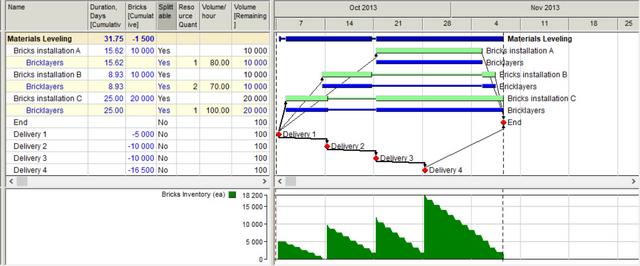
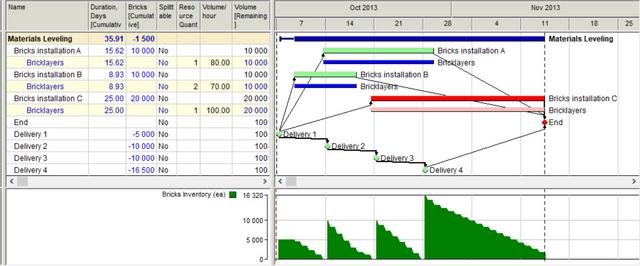
The following resource leveled schedule can showcase different production rates and what happens when planning for all installation activities allows splitting.
Not leveled schedule showing materials overload.
Leveled schedule allowing for activity splitting.
Leveled schedule not allowing for activity splitting yields a longer duration schedule.
Loaded Images are disappearing after some time. I this planned or an error in te CMS.
I suggest you use an external filehosting for images.
Latter will take a look at your reply, meanwhile please check my interpretation of the schedule, you know better how P6 works, I get confused with it.
You said - In this smoothing process, I have used a max.units/ per time of 700 bricks. So the availability of the material resource is set at 700 bricks a day.
But what happens if the installation rates for different walls is different because their degree of difficulty? On any given day the resources might be working at different rates, a common scenario in construction jobs. Some days the maximum number will be 500/day, other days will be different. Will the P6 threshold be the same?
You said - This is easy in P6. You can specify different max.time/time Per calendar.
But what happens when the delivery is not fixed by calendar dates but by the finish of some predecessor activities? This I use for modeling of Spatial Resources such flying forms for elevated slabs that must remain in a building until structure is completed and last pour can be stripped. A common scenario in all my jobs.
Cordially,
Rafael Davila
Hi all
Raphael
Hereunder you find the answers
1* Production rate is established ai 0.01hours/ brick for “normal.” walls
Production rate for walls around doors and windows 0.06 hours/ brick
For the example, I have used a combined rate of 0.12 hours/brick
In The Netherlands, you may order more than 20 sizes of bricks. I have assumed 75 bricks per meter square
The purpose of the example I provided is to debate on the benefits of resource Optimization techniques. These consist of resource leveling and resource smoothing. The aim for the scheduler is to balance the resource availability or assignment is a better word, against the resource requirements.
In the example, I have used this two optimization techniques. For the resource leveling of the Bricklayers, I have used a max units/ per time period of 16 hours a day. I have used as, in Raphael’s example ever week 5000 bricks delivered on Monday.
In this smoothing process, I have used a max.units/ per time of 700 bricks. So the availability of the material resource is set at 700 bricks a day.
So now we have the availability set for both the resources and these as I have called, ‘Leveling Specification.’ loaded in Primavera P6.
So, as you can see in the examples, the histograms in the unleveled position are different because one is for bricks and the other is for labor man hours. So, what’s next?
I have first leveled the material resource, bricks, As you can see, the completion date is established after at 04-Oct. 2017
Secondly, I have leveled the labor resource ‘Bricklayers.' As you can see, the completion date is now 20-Sep. 2017
What one of the features of resource smoothing is that we sometimes are not able to optimise all resources.
You have to make choices, streamline the material delivery or optimise the output of the bricklayers. What I could have done is to match the availability of bricks exactly to meet the production rate of the Bricklayers, but that would have defeated my purpose of the debate.
I have designed the example in such a way that a choice would be obvious to make. Go for the date of 20-Sep. 2017 or for the completion date of 04-Oct-2017 or find the other solution.
Vladimir, to answer you question.
An example supposes that bricks are supplied in individual speed (5000 per week). It is not always true in real life projects. More interesting is the case when supply is different each week, like 6000 on the first week, 4000 on the second week and 5000 on third. The original example is too simple. And intervals between the supply events may be different also.
This is easy in P6. You can specify different max.time/time Per calendar. For example. 700 bricks in week 1, 1000. In week 2 and 600 over the next four weeks. The leveling engine will follow this.
Raphael,
Could you disclose your thought so that we can learn from you?
Webmaster
Loaded Images are disappearing after some time. I this planned or an error in te CMS.
Regards
Johannes
1.
Vladimir,
I cannot follow the logic on Johannes schedule, he talks about production rate of 700 bricks/day but the activity durations do not match.
I guess given some time and with a lot of patience I could learn some P6 Frenchglish but if it cannot deal with different deliveries amount that would be unacceptable. P6 jargon is not what we speak at the jobsite. We do not say you have 16 man hours and two 8 hours days. This can be interpreted as 1 person working 8 hours/day for two days or 2 persons working 4 hours per day for two days. Even if you provide workload ratios we do not make the calculations on the job-site for thousands of resource assignments.
The reasoning behind P6 for leveling effort instead of quantity I find in error, quantity and effort are not the same; resource leveling for effort under partial workload can yield wrong results, at times on the optimistic but wrong.
It did not split any of the activities as my sample schedule would, so it is not a good example as to showcase what happens when activity splitting happens. In such simple scenario I would not expect much difference.
Let me know if I got Johannes model right, more interesting shall be Johannes response to my proposed scenario. BTW a scenario proposed by the author of this discussion prior to his own I have taken the courtesy to model.
Once Johannes has it finished then we can try your suggestion of making brick deliveries as well as all others with more variations. It shall be easy as it will only require changing some delivery values.
Best Regards,
Rafael
Johannes,
An example supposes that bricks are supplied in certain speed (5000 per week). It is not always true in the real life projects. More interesting is the case when supply is different each week, like 6000 on the first week, 4000 on the second week and 5000 on third. Original example is too simple. And intervals between the supply events may be different also.
Johannes,
P6 calculations are unreliable but I believe in this case there is more than P6 unreliability. A simple report that details on a daily basis how bricks are consumed and produced is enough to show if it is wrong.
As soon as brick inventory/cummulative/running values go into the negative there are no bricks to install !
Next figure displays how daily inventory is accrued per activity using standard software report.
Best Regards,
Rafael
Hi all
I have updated and edited the original post and added screenshots.
Please scroll down.
Regards
Johannes
After making sure the start of project matches this is what I got it is not a good solution, is unfeasible. Easy to verify if fixing dates using start no earlier than constraints and look for overloads.
SORRY THE IMAGES GOT LOST - Until provided with readable images by Johannes I cannot create them again.
I tried Johannes example but got different results. If to use activity priorities defined by their order:
If to ignore activity priorities:
I will assume bricks quantity is not proportional to wall area and will use non-labor units as to mean number of bricks. It is weird to name quantity as "units", I wonder what is the name for unit of measure. At home if you say 10 bricks it means quantity 10 and unit is bricks, 10 is not the "units", must be some combination of English and French. I can figure out Spanglish but not Frenchglish.
Vladimir,
The first image provided is the unleveled schedule and the second one the leveled schedule by Johanes. Should be easy to create the model in Spider if readable and all required information is there.
Lets see how Johannes work out the scenario I submitted.
I tried to look at Johannes link and found that my location is blacklisted.
So No comments!