Why Testing Scheduling Deep Reasoning Matters
As we see these new frontier models emerge, it is worth highlighting why benchmarking deep reasoning capabilities in scheduling is important:
The Universal Baseline Across All Use Cases: Deep reasoning is the foundational orchestration capability that everyone relies on across all applications. Whether a model is analyzing a schedule, parsing a contract, or solving a logistical problem, it defaults to this underlying zero-shot reasoning, especially when it lacks access to external data, live feeds, or third-party plugins. When vendors and developers build commercial scheduling AI tools, they are fundamentally building on top of this baseline. If the core scheduling reasoning is flawed, any solution built upon it will ultimately struggle.
Impact on Scheduling Document Analysis and Reporting: Strong scheduling reasoning is not just about theabstract math or logic; it drives everyday practical applications. For tasks like analyzing complex project documents or drafting schedule narratives, a model that excels in native reasoning about scheduling has a much higher probability of delivering higher first-pass accuracy, maintaining strict context, and requiring fewer prompt iterations from the user, saving time and money on the way there.
The Cost vs. Performance Trade-off
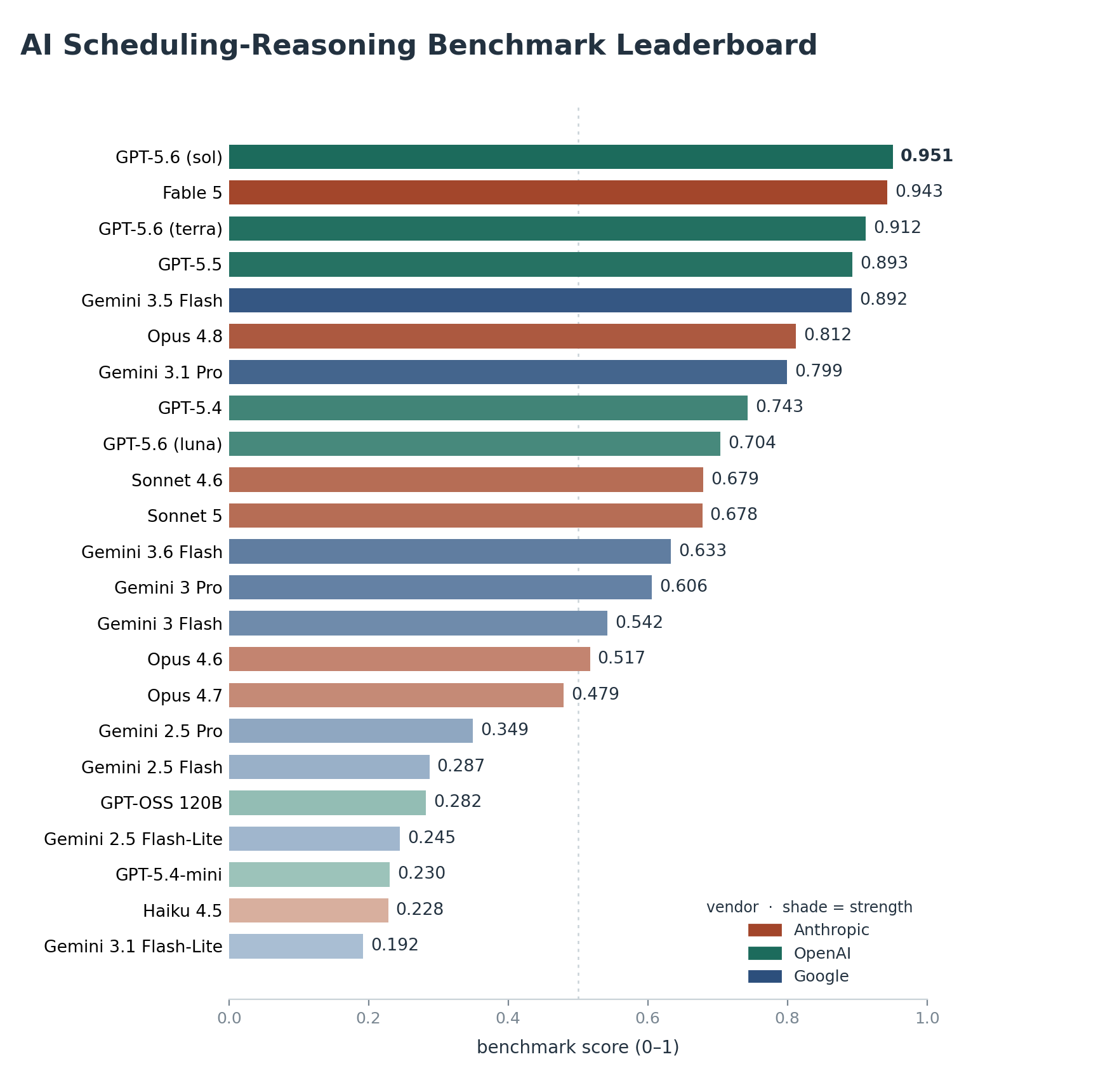
One of the most striking results is what the leaderboard reveals about efficiency. Gemini 3.5 Flash (0.892) delivers near-flagship performance, hovering right behind the heavyweights GPT-5.6 (sol), Fable 5, and GPT-5.6 (terra) and it does so on a lightweight "Flash"-class model at a standard, mid-level reasoning-effort setting. For real-world applications where cost and inference latency are critical, that is an incredibly compelling trade-off.
However, the new Gemini 3.6 Flash scored lower than 3.5 Flash on scheduling / project-controls reasoning with effort-matched (low/medium/high).
Headline: ~2.6× faster, but a clear drop in scheduling reasoning accuracy.
- Accuracy (effort-matched): trails at every setting with 62% vs 82% at high, 62% vs 89% at medium; gap narrows only at low (32% vs 38%).
- Speed: ~2.6× faster at high/medium, and more consistent.
- Efficiency: the size of the speedup points to far fewer reasoning tokens which means it thinks less per query.
Google's "faster & efficient" claims hold but it's a deliberate trade-off that the headline does not say. 3.6 Flash reasons less and pays for it in accuracy in the scheduling reasoning tasks especially in the domains below:
- Calendar/working-day math collapsed: the most dangerous failure mode because it's confidently wrong on timelines and dates!
- Resource scheduling, leveling, schedule-quality: double-digit drops; the multi-step tests are where it stopped thinking.
Let me know if you have any questions.