Many schedulers build PDM networks that calculate the effect of a change incorrectly! Use the wrong combination of links and the effect of shortening a critical activity is a delay in the overall schedule.
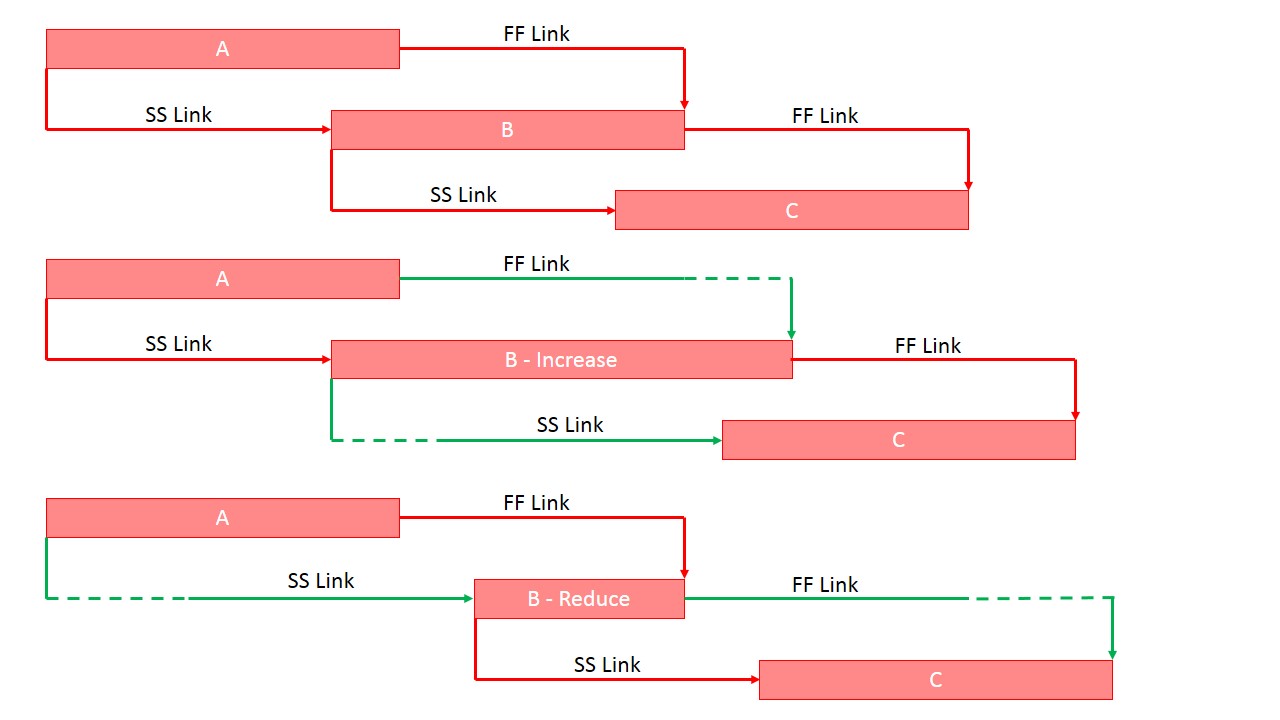
This post looks at five logical constructs that generate illogical outcomes from a changed duration: https://mosaicprojects.wordpress.com/2016/06/12/critical-confusion-when-activities-on-the-critical-path-dont-compute/



Dear All,
Please let me know how to print activity links in Primavera 6 as my management want to see link for all activities.
Thanks
Sagar Hassan
To say the reality of PDM scheduling and the legally accepted definition of the Critical Path are in conflict IS WRONG because:
1) You can model contiguous as well as non-contiguous durations if using P3, a PDM scheduling software, technically there is no such conflict.
2) Some activities shall never be planned as of non-contiguous duration such as a de-watering activities, concrete pouring activities and concrete finishing activities, to name a few. These activities shall be modeled using contiguous duration rules; you cannot model contiguous if using non-contiguous as you will lose control on the activity duration because at any time it can become non-contiguous, therefore to prohibit contiguous duration models across the board on these activities is non-sense, too much on delay claim paranoia.
3) Activities that can be of non-contiguous duration shall be modeled as such; you can model these activities as of non-contiguous duration if using contiguous model simply by splitting the activity; easy, under control and transparent. This approach is a better approach as it is more transparent, it exposes true intent on whether scheduler needs the activity to be contiguous or to be split and how. It also can disclose some necessary float metrics as to better understand the implications of changes in activity duration when critical as well as when not critical. The need for control and transparency is not hard to understand.
4) Any software that cannot model such contiguous activity rules, even in the case of SS & FF links between two activities, shall be avoided.
5) Contiguous Activity duration rules are not in conflict with critical path definition, in some cases it is a must, in other cases a better choice, in other cases a poor choice. These are rules any scheduler shall understand, you just use the applicable rule at the activity level. Global non-contiguous rules for activity duration as implemented by defunct P3 are non-sense unless used exclusively for some comparison purposes, in a similar way some "banned" constraint types were intended to be used. Unfortunately some schedulers insist on miss-using such global settings.
http://warnercon.com/wp-content/uploads/2012/07/Article-7-Use-of-Milestones-and-Constraints1.pdf
6) In our courts, at least in my jurisdiction, schedules are considered incomplete if there are resource constraints not being considered. Ironically most CPM software such as MSP and P6 cannot yield reliable values of resource leveled float. The hands down approach is to use the model to disclose cause and effect. Each party presents its own case and here is where the conflicts begin. In some occasions a contiguous activity duration is appropriate in others it is not, usually it is a matter of contractual conditions and risk allocation. Placing too stringent conditions on how the responsible for the means and methods can be seen as a no-damage for delay clause, usually enforceable if obvious, usually not seen with good eyes. A software developer that advocates too much for such restrictive conditions would not be welcomed by construction contractors.
Most Spider Project schedules, if not all, are aware of the issues with contiguous and non-contiguous models, it is clear within the appropriate float values, most of which can be graphically displayed. So obvious!
With regard to the statement that most lawyers and tribunals will never understand the issue. I do not agree, the rules are easy to understand. I do not believe it takes much brain as to realize what will happen if an activity is broken into several segments or not. Perhaps the use of expert witnesses just add to the confusion. Usually here most cases are solved by using common sense the judge can rationalize in his determination.
1. If the dependencies in your examples are set properly then they are not ladders.
2. There are many definitions of Critical Path. I don't know if zero total float definition is legal in your country.
3 and 4. Maybe but was not discussed here.
There are two very distinct outcomes from this discussion
1. There are some specialist options in a limited number of tools that mitigate or avoid the problems highlighted in the paper (but there always have been - ADM 'Ladders solved the problem in the 1960s).
2. The reality of PDM scheduling and the legally accepted definition of the Critical Path are in conflict.
3. Most schedulers seem blissfully unaware of the problem.
4. Most lawyers and tribunals will never understand the issue!
Pat.
While Miklós warns about how added PDM functionality can complicate things to the unwary scheduler he further expanded the functionality of traditional PDM discrete links to a single type, he is embracing them all plus more.
https://open.library.ubc.ca/cIRcle/collections/52660/items/1.0076408
Any of the constructs can be modeled using different rules for activity duration [fixed/intermittent/elastic] as exposed in his paper. Miklós is not calling them wrong but advise schedulers to make sure they are aware and understand which rules are used and how are implemented by different software.
https://books.google.com.pr/books?id=lhugvCwsWCUC&printsec=frontcover&s…
Page 165 of this preview give us some of Miklós recommendations.
6- Use the activity-splitting-not-allowed approach since this is the original PDM assumption. The non-splitting approach provides you information on the early and late accomplishing of the activities, while the activity splitting approach usually does not.
7- If it is inevitable, then the activity splitting approach can be used, but remember that after this you make connections between the *start event’ and ’finish event’ of the activities and not between the activities themselves.
8- Be careful in case of disputes or when working with other schedulers. First you have to check whether your ideas about PDM are concordant.
These rules help to prevent the schedule from becoming confusing or incorrect.
My approach is to use activity-splitting-not-allowed and if inevitable to split the activity into individual contiguous activities keeping control at the individual activity level.
A single rule for calculation of activity durations as well as a single rule for resource leveling splits is not good enough, not all activities require same rules.
http://archibaldassociatesllc.com/paperspresentations/problems-methods-…
Knowing activity flexes and super floats allows managers to optimize resource assignments on specific activities and to understand if activity performance can be interrupted and for what duration.
Patrick,
"Uninformed" is not a term that I would normally associate with either Vladimir or Rafael.
I think your paper - and the comments here - do well to highlight the pitfalls of non-FS links in PDM schedules. Certainly the existing dominant tools in the US (P6 and MSP) are susceptable to them, and it would be good for some alternative approaches to gain traction.
I wrote a similar article to yours - mainly focused on application in MS Project and using the BPC Logic Filter add-in: http://wp.me/p6CCB4-3H. I'm not sure that most of these structures can be reasonably avoided - especially when attempting to model large-scale linear construction.
Dear Engr,
Good Day,
My question is how to keep relationship while copy the activity in the same WBS.
for ex Activty A have a relationship more than 50 links to other activity with the different WBS, i need to copy a activity A mean whilr i should keep the existing relationship.
awaiting for your valuable reply
Same as Vladimir I don't see the problem in the fact that there are many ways activity duration changes may influence project duration.
Old Primavera P3 PDM Networks had some rudimentary Schedule/Level Calculation Option that was applied across the board to all activities Schedule Durations but Primavera P6 abandoned this option in favor of a contiguous activity model.
See page 29.
• P6 does not have an interruptible activity setting. This means that the schedule cannot split activities and their resource requirements to allow for more precise resource allocations.
• The resource leveling process cannot adjust activity durations, thereby adjusting the daily resource requirement.
• The activity Total Float and Free Float values displayed are incorrect for resource leveled delayed activities and their successors. A better reference is found in the Remaining Total Float column but even this does not fully reflect ‘resource float.’
Patrick, with the current data certain activity sequence determines project duration and constitutes critical path.
DRAg shows what happens if the critical activity duration becomes smaller. Negative DRAG indicates that project duration increases, positive DRAG shows that it decreases.
In any case with the current data certain activity sequence is critical, with other data it may not. I don't see why some data changes determine criticality. Critical Path may change if some activity duration is changed, calendars change, resource allocations ,change, mandatory constraints change. It does not make current critical activities non-critical.
Criticality may be discussed not from the data changes point of view but considering activity delays. If activity delay increases project duration then an activity is critical.
I'm rather surprised by these ill-informed comments - the fundamental definition of a critical path is 'the sequence of activities that determine the earliest possible completion date for the project or phase.' If the activity takes more time to do but the schedule takes less time to complete, surely there is a problem n the PDM methodology.
the paper is not academic - on a number of occasions as an expert in court, I have destroyed claims by the other side simply by using the schedule agreed under the contract to show the alleged delay to an activity in the schedule had no effect on the project completion and therefore there was no compensatable delay to the project.
I know sophisticated tools such as Spider can avoid the problems and agree with Rafael that the calculations are entirely predictable but neither of these observations changes the facts for 99% of the project schedules in existence today.
Pat.
All of the constructs outlined in the reference will produce the right information, that someone does not understand how the contiguous model works is an issue not everyone have. The outcomes are correct and very logical indeed and are what shall be expected of a contiguous model. The contiguous model is superior because it gives the user more control.
For lag drag there is no such thing as a single solution that fits all.
Automatic rules to solve the "lag drag effect" that occurs when an increase in activity duration reduce start of a successor issues are wrong.
Lag Drag is an issue to be addressed when present and only when justified the activity split, a reduced workload or a combination shall be executed in a controllable way, easy solution is wrong, not a good approach.
Well, I don't see the problem in the fact that there are many ways activity duration changes may influence project duration.
DRAGs show this.