Hi my friends,
I would like to discuss some cases that I faced today. I'm leveling material from Spider but, I think that algorithm always considers that if you do not use the material in each period the same material goes to another period for use. The cumulative concept that's right for materials like bricks, gravel, cement and others but, for leveling composite materials like concrete and asphalt, that do not consider stock in real life the way is different. Spider have some key for not considering this? According picture bellow the leveling works very well because Spider consider that quantity not consumed (8units) in 11/30/21 will be cumulate and will consumed 12/01/21 together other, even resource Truck do not capacity (992units consumed) faced (1000units income (produced)). In systems where the material is produced and this product must be 100% used the stock concept is right? Have some way to consider this situation?
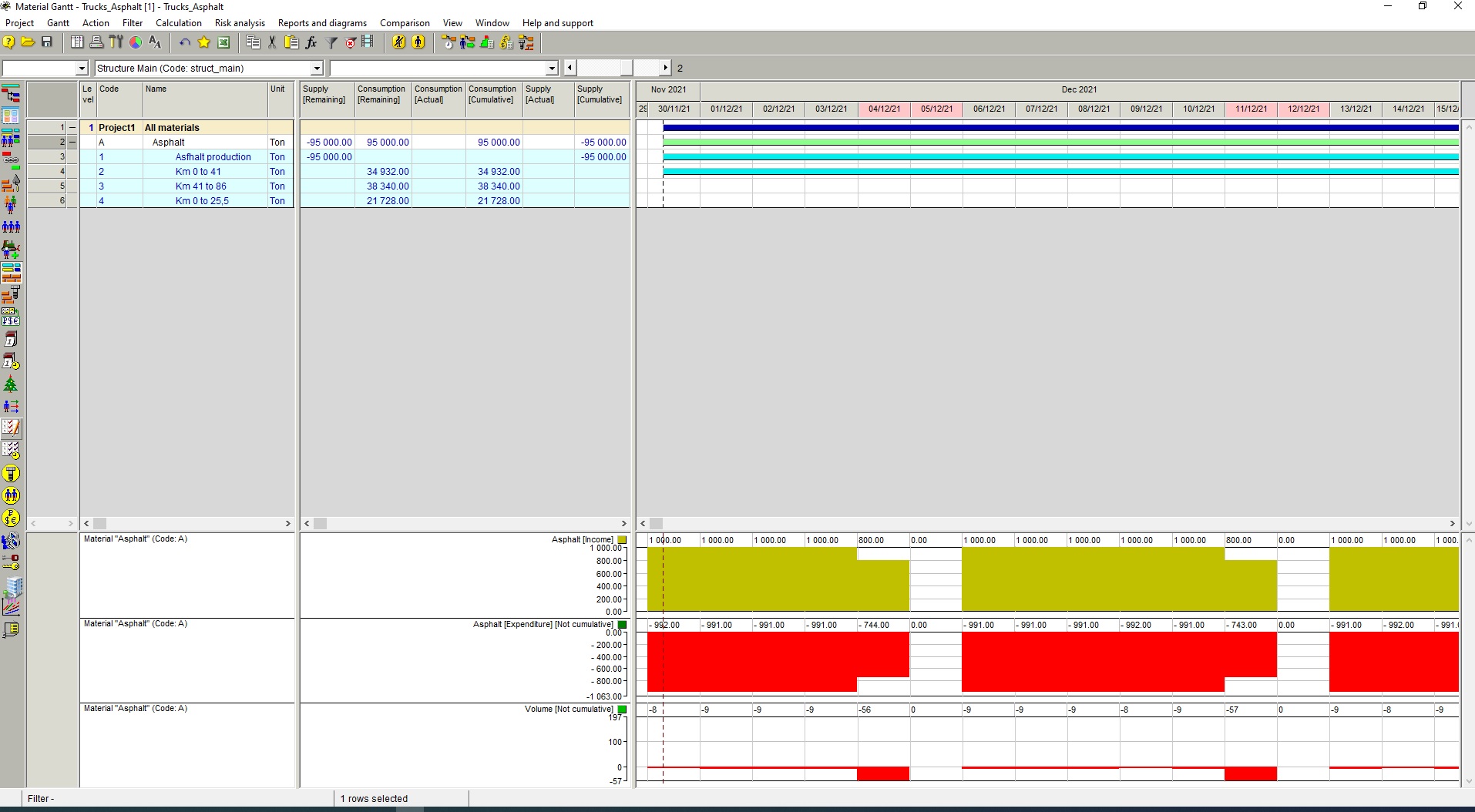
Follow file link,
Best Regards,
Daniel Morais



Hi Bogdan,
"I looked over your model and I have a very simple question: Why does the asphalt usine have more work hours/day than the trucks? Also why does the start of work day of the truck = the start of the asphalt usine?" Yes you're right i will check and fix it. I tried input the conditin of real life but i do a mistake of a concept and do not saw this detail, thanks.
"I don't know the exact process but if the asphalt usine works 2 hours/day than the truck what happens to the asphalt that is produced after the truck day ends? Even if there are some technological times to start/stop the asphalt usine these should not be included in the schedule because Spider will consider them production times for the asphalt." Yes, you're right.
It would make more scence to have the asphalt usine work more than the trucks but the start day of the truck would have to start afther the asphalt usine. Yes, you're right i will fix it, thanks.
Best Regards,
Daniel
Hi Rafael,
I understood and works fine but a little doubt, the number 12x8.26x100=9912 on resource "productivity" must some function? or you put only for explain better?
Best Regards,
Daniel Morais
Daniel,
what Rafael is proposing is very good.
I looked over your model and I have a very simple question: Why does the asphalt usine have more work hours/day than the trucks? Also why does the start of work day of the truck = the start of the asphalt usine?
I don't know the exact process but if the asphalt usine works 2 hours/day than the truck what happens to the asphalt that is produced after the truck day ends? Even if there are some technological times to start/stop the asphalt usine these should not be included in the schedule because Spider will consider them production times for the asphalt.
It would make more scence to have the asphalt usine work more than the trucks but the start day of the truck would have to start afther the asphalt usine.
Best regards,
Bogdan
With some cell specific formulas and a script Spider can adjust the production resource quantity (#trucks x truck_productivity x 100) and instead of fixing the number of trucks you migh use variable quantities for Spider to figure it out.
12x8.26x100=9912
I usually find it easier and a better fit to use multi-resources and skills with no need for complicated formulas, just use a few crews with increments in size.
Hi Rafael,
This is true, but I would like to test and guarantee that the material produced is well consumed according trucks dimensioned. If Spider can calculate too the quantity of trucks will be amazing (considering that material like asphalt and concrete are not stockable).
I'm not sure if the modelate how hammock and MH (Man Hour) resource if will won't lost the condition IN/OUT = zero (ideal condition), I think that with material is more sense. Because this way the flow would be "Consume to production" or activity type "productivity" to activity type "hammock" when the correct flow shoud be "Production to Consume".
Best Regards,
Daniel
As asphalt is consumed as soon as it is produced it is not a constrained as a consumable resource. The constraint is on the production rate ant it can be modeled as a renewable resource whose available quantity is the maximum production rate.
To get more granularities with the production rate I am multiplying the quantity for resource "rate" by 100.
https://www.mediafire.com/file/vs66ht2k26vklkw/Trucks_Asphalt03.001.sprj/file
Hi Bogdan,
Follow my answers:
A. No, the production of asphalt usine are according with the real cenario in construction, 100ton/h into of calendar real. This production don't need be increase or decrease it's already adjusted.
B. Not only increase but decrease too, depending on the production. Should be interesting if we could calculate the quantity of trucks, (according with the produtivity, workload and volume sets) for use all asphalt produced.
C. This would not be the main idea and desire, but I understand that it would be a consequence of after all the leveling calculations.Best regards,
Best Regards,
Daniel
Hello Daniel,
I read all the posts and I have a couple of questions, regarding the purpose of the model related to material leveling?
Here are some scenarios I though after reading the posts:
A. You want to adjust the prodction of the asphalt usine in order to produce less than the maximum capacity?
B. You want to be able to increase number of trucks in order to lay all the asphalt produced considering the maximum capacity of the usine?
C. You want to leave the model as it is but calculate the monetary loss for each day based on asphalt that has not been layed?
Best regards,
Bogdan
Hi Marcus,
The concempt applied is wrong because the sum of 3 bar bellow (activities) must be exactly the same time to bar above (production) because everything that is produced must be consumed, remember this material don't consider stock.
You Second schedule show that happen cumulative stock of material for after be consumed, don't can this way, everything produced on day must be consumed on the same day, if happen some sold, the must be considered how lost.
Best Regards,
Daniel
Hi Daniel and Vladimir,
I made a short video, trying to understand what you presented as an obstacle. here
Imagining some a limited supplier (asphalt) and limited resource quantity (trunk), considering the SPRJ sent, I made some simulations.
I considered a regular common calendar 7 days a week, 10 hours, and a limit of 100tons asphalt production, 3 road construction activities consuming asphalt according to its length.
Take into consideration that an activity will only begin if there will be enough material to support it.
Please take a look and inform any mistake / misunderstood in the model I made. by CPM calculation ...
I recorded it in Portuguese :)
by CPM calculation ...
[[wysiwyg_imageupload:8012:]]
by Resource Leveling + LSM
[[wysiwyg_imageupload:8011:]]
file SPRJ is here: https://www.dropbox.com/s/m1nkhu3b3ttwtui/Trucks_Asphalt.001.sprj?dl=0
Ok Mr. Liberzon, thank you for answer. I think this is important feature because for example Eolic Farms (concrete trucks) and Roads (dump trucks) the material leveling is excellent way for balacing the best quantity of resources according the material production (consumption). The Spider algorithm can be an excellent support for the best decisions where many times this resources can be expensive if bad dimensioning.
Best Regards,
Daniel Morais
Hi Daniel,
this task is not trivial and today Spider Project does not model this case.
It is necessary to adjust material production to consumption if maximal consumption is less that maximal production capacity and adjust the number and workloads of assigned resources if maximal consumption exceeds the production capacity.
We will think about the best way to model this task but today this can be done only manually.