What is your preferred method to link a task that starts after the first occurrence of a series of events?
Example - you have a schedule to deliver six widgets A1-A6. After the first widget is delivered a widget support period A7 starts. But you don't know exactly which widget will be delivered first.
How would you link A7 to all six widget deliveries A1-A6 so that its start date always aligns to the earliest delivery? Would this work if another widget is delivered earlier? What would be the logic if A7 was a task dependent activity? What if it was an LOE?
Task IDTask NameA1Deliver widget AA2Deliver widget BA3Deliver widget CA4Deliver widget DA5Deliver widget EA6Deliver widget FA7Widget Support Period



What if it was an LOE?
https://docs.oracle.com/cd/F25600_01/client_help/en_US/helpmain.htm?toc…
Any P6 scheduler should know how to create it and understand how limited they are. They cannot be resource leveled and cannot drive successors. If you need the activity to drive successors and use another activity type. Anyway, this question was satisfactorily answered.
How would you link A7 to all six widget deliveries A1-A6 so that its start date always aligns to the earliest delivery?
What would be the logic if A7 was a task dependent activity?
Questions still pending to be answered. It looks like P6 cannot tackle such a simple challenge.
https://docs.oracle.com/cd/F25600_01/client_help/ar_EG/helpmain.htm?toc…
Use task dependent activities when multiple resources assigned to the same activity need to work together. The idea is to use them along with P6 resource loading and leveling, and to drive their successors.
As with most scheduling software using traditional activity hard links is not the answer; with Spider Project we use consumable resources leveling for the software to create the temporal links/logic and meet the schedule requirement for some activity to start after a certain number of activities starts or finishes, a dynamic model that will always get it right.
@Rafael, correct me if I’m wrong, but my understanding of a task-dependent activity is when a project task or milestone can’t begin until the start or completion of a separate task depending on the relationship assigned, therefore A7 was relying on A1-A6 before it can start. Anyway thats only an option and it was also mentioned, ‘What if it was an LOE?
Yes, Rodel, but the requirements also asks for "What would be the logic if A7 was a task dependent activity?", an activity that can drive other activities and can be resource leveled.
I agree with you, @Rafael. P6 LOE is considered a dummy activity as it does not drive the successor activity. However, if you read the requirements, the driver is the "Deliver Widget" activity, which initiates the "Widget Support Period" activity, making P6 LOE a perfect fit for this purpose. It's similar to "Management Support" activities, which are usually defined using LOEs.
Primavera P6 Level of Effort activities are also non-driving; they do not affect the start date of successor activities. They therefore are not a schedule duration influencer.
https://tensix.com/primavera-p6-level-of-effort/
Alternatively, in P6, you can utilize LOE activity "Widget Support Period" within the same WBS or in a separate WBS. Link all "deliver widget" activities starts using SS relationships (with or without lag, depending on your requirements), and link all finish dates using FF relationships (with or without lag to suit your needs). The LOE activity will automatically commence when the first "delivery widget" activity starts (with the option of lag or no lag to determine its start) and conclude when the final "delivery widget" activity finishes (with the option of lag or no lag to determine the completion of the widget support period after the final delivery).
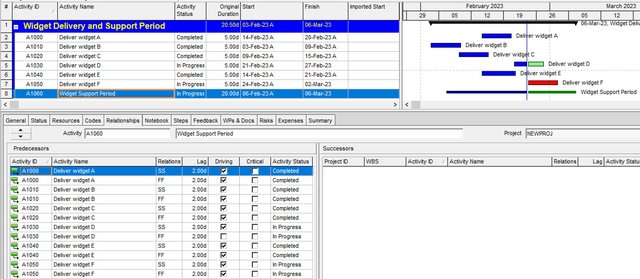
Solutions are different for different scheduling tools.
Spider Project
Use production and consumption of materials. Commencement of the "Deliver widget' activity produces a token (special material), the successor activity can commence when 1st token is available. More complex scenarios could be simulated as well. Like start, an activity when first 3 activities commenced (or completed).
MS Project.
1. Add 6 milestones and put them in a separate Summary Group (aka WBS) "Start Delivery widgets".
2. Link each milestone to the related widget activity by "Paste Link" feature (special past).
3. Link the "Start Delivery widgets" summary task with the 'Widget Support Period' activity (FS)
Primavera
1. Ass summary WBS Summary activity to WBS with the deliver widget activities.
2. Link the WBS Summary activity with the 'Widget Support Period' to (FS).
Regards,
Alex Lyaschenko
Micro Planner X-Pert offers a Reverse Logic Node changes the normal network logic that requires all of the preceding tasks linked to the node to be completed and/or the link constraints to be completed, before the event is triggered and the following task(s) can start. The Reverse Logic Node allows its successors to start as soon as one of its predecessors in complete.
But this is the most elementary of such requirements, it is also common to require successors to start in batches as shown in my prior posting. It would be interesting to know how Micro Planner X-Pert handles the requirement to allow the successor to start after 3 of its predecessors is complete.
Best Regards, Rafael
Patrick,
as you may learn from this discussion, Spider Project has this functionality.
Micro Planner X-Pert has an 'Reverse Logic Event' for precisely this purpose - it allows it's successor to start as soon as the first of its predecessors are complete. For more on this see: https://mosaicprojects.com.au/PDF-Gen/Links_Lags_Ladders.pdf (page 18).
I don't know of any other tool that faciitates this need.
We use consumable resources production and consumption for such simple model.
As easy if considering start after finish or a combination of similar constraints.
All of the above activities share a WBS code.
Widget Support Period is a WBS Summary activity type.
This aligns start date, but does not define end of the period.
All of the above activities share a WBS code.
Widget Support Period is a WBS Summary activity type.
This aligns start date, but does not define end of the period.