

Dear Planning Planet Members,
Welcome to the newsletter; did you know that this newsletter goes to the largest community of project controllers on planet Earth? As many of you know we’ve transitioned to a new, faster, and more modern web portal that’s already benefiting our users. We appreciate your ongoing feedback in identifying the bugs or issues we need to fix.
Written something on project controls—an article, a thought piece, or even a rough idea? Get in touch and we’ll include it in future posts. It’s free, and we love collaborating with our community.
WHEN LOGIC BECOMES FICTION: THE HIDDEN SABOTAGE INSIDE SCHEDULES
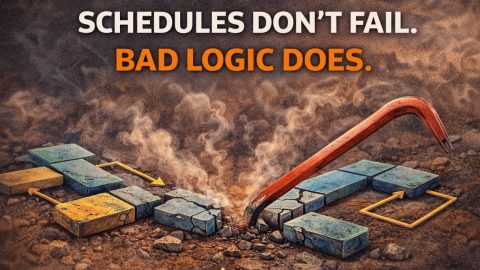
In project planning there are two ways to lie without explicitly lying: one is inflating durations to “create buffer,” and the other —far more dangerous— is manipulating logical relationships and constraints. The first one is visible and easy to challenge. The second one hides inside the model and is therefore harder to detect, easier to defend, and more destructive. That is why it has become the preferred mechanism of politically correct schedules: a schedule can look flawless, full of logic, perfectly aligned to reporting expectations, and still be operationally useless as a control tool. In fact, the paradox is brutal: the more “tied down” a schedule looks, the more fragile it often becomes during execution. The reason is simple: logic should model reality, not anxiety.
Logical relationships were created with a clear technical purpose: to represent real dependencies between activities. They are the structural language of CPM models. Yet in many infrastructure projects, relationships are not used to represent reality, but to force the schedule to behave. Finish-to-Start becomes the default choice, as if execution were a disciplined single-file line, when everyone knows real construction behaves through parallel work fronts, synchronized finishes, partial releases, and phased handovers. When dependencies are modeled incorrectly, the schedule does not only create artificial sequences. It manufactures false critical paths, produces fictional float, and destroys the ability of the model to explain what truly governs project time.
Even worse, lags are often used as anesthesia. In theory, lags are legitimate when they represent unavoidable physical time: concrete curing, coating drying, stabilization periods, testing windows. In practice, lags are frequently used as spacers to make dates match, to hide missing engineering maturity, to cover absent permits, or to compensate for lack of resources. That is where the model becomes dangerous: a lag has no operational identity. No crew manages a lag. No one executes a lag. A schedule full of unjustified lags becomes resistant to control because it loses traceability and becomes difficult to audit. The schedule remains clean. The field becomes chaotic.
Then comes the most silent poison: over-linking. When every activity has five predecessors and seven successors, the schedule loses analytical value. It becomes rigid, fragile, and domino-like. Any small change triggers cascading impacts not because the project truly behaves that way, but because the model was built like a trap. A hyper-connected schedule is not a robust schedule —it is a nervous schedule. And this must be said clearly: many over-linked schedules are not built out of technical rigor, but out of fear. They are tied down because someone wants the bars to stop moving, as if visual stability were the same as operational stability. That is cosmetic control. And cosmetic control is the prelude to collapse.
This is where constraints enter the conversation —probably the most misunderstood scheduling tool in modern project controls. Constraints are not inherently wrong. In fact, they are necessary. Infrastructure projects are full of non-negotiable external limits: permit approvals, environmental windows, owner access restrictions, utility outage windows, energization dates, contractual handover requirements. In those cases, a constraint is an act of honesty. It represents something the project does not control but must respect. The problem begins when constraints are used to freeze the schedule, defend a narrative, or prevent deviations from appearing. At that point, constraints stop representing external reality and become a sabotage mechanism.
Source: Jair Aguado Quintero. I.E, MBA, PM4R®, SpS.
COMPLEX RESOURCE ASSIGNMENTS MODELLING
Critical Path Method (CPM) can be built without complex resource modelling: planners typically develop a logic-based schedule first and assign resources afterwards.
In practice, though, this sequence often breaks down because resources are not just inputs to activities – they frequently govern activity durations. Duration is shaped by crew size, productivity rates, learning curves, and calendars, so the relationship between resource quantity and duration is rarely linear.
On top of that, resource supply can be constrained, shared across projects, and volatile over time. As a result, a purely logic-driven CPM schedule may be mathematically “correct” yet operationally unrealistic.
To produce a schedule that reflects feasible execution and can be calculated reliably, complex resource assignment modelling must be applied, not treated as a post-processing step.
Think of the next scenario:
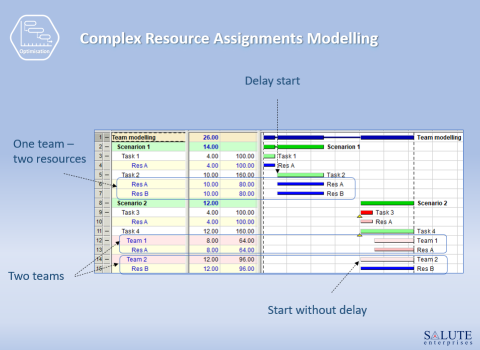
Two resources are assigned to an activity, but only one is available. Should the scheduling system start the activity as soon as the first resource becomes available, or wait until the second one is available?
There is no single correct answer, as both scenarios are valid in real projects, depending on the nature of the work.
Consider two simple cases:
- Moving chairs: the activity can start with one resource and finish without the second. It may take longer, but it is still feasible.
- Moving desks: the activity cannot start unless both resources are available. One person alone cannot begin the work.
Other common examples include:
- An activity that requires an excavator, where more than one excavator can be used if available.
- System integration testing, where some test cases require two testers, while others can be executed by one.
For a project delivery model to be reliable, both scenarios must be explicitly supported. This means that planners (and the scheduling systems they use) must be able to define assignment logic, not rely on assumptions.
Source: Alex Lyaschenko
THANKS FOR THE VOLUNTEERS & FEEDBACK - FREE, OPEN, COLLABORATIVE & EVOLVING - PROJECT CONTROLS GUIDELINES

The market place is full of standards, recommended practices and bodies of knowledge. We seek to provide a simple guideline(s) that would be a useful tool to everyone, from beginner to expert - easily understood.
Instead of competing with existing standards, we want to curate, simplify, and distill them into something accessible and practical for all levels of expertise. That’s powerful because it positions our guideline as a bridge between complexity and usability. Guiding Principles:
- No Reinvention: Avoid duplicating definitions.
- Distillation: Extract the essence—what practitioners actually need day‑to‑day.
- Accessibility: Use plain language and keep it simple
- Community Value: Make it free, open, collaborative, and evolving with feedback.
- Scalability: Later work could scale it from novice to expert
We have a team of senior, seasoned practitioners who are already collaborating. If you wish to get involved please email [email protected]
ESTIMATING CONFIDENCE DOES NOT COME FROM PRECISION

One of the most persistent misconceptions in estimation is that confidence comes from precision, it does not. Credible estimates do not conceal uncertainty — they make it explicit.
Early estimates are inherently uncertain. That is not a failure of competence; it is a consequence of incomplete definition. As information matures, uncertainty reduces. Until then, pretending otherwise introduces risk rather than removing it.
Modern estimation practice reflects this reality by:
- Expressing estimates as ranges, not single-point values
- Making assumptions explicit rather than implicit
- Linking confidence levels to scope maturity, not optimism
A single “most likely” number creates an illusion of certainty , a well developed and defensible range enables informed decision-making.
Estimates should and must evolve over time:
- As scope definition improves
- As risks are retired, realised, or priced into the baseline
- As empirical delivery data replaces early-stage assumptions
The estimator’s role is not to eliminate uncertainty. It is to characterise it clearly enough that decision-makers can act intelligently.
This is where the Basis of Estimate (BoE) becomes critical. A robust BoE explains:
- Why the range exists
- What assumptions underpin it
- What factors would shift it
- Where professional judgement has been applied
Uncertainty that is explained strengthens confidence, Uncertainty that is ignored — or disguised as precision — erodes it.
How do you keep your uncertainty register up to date and relevant?
Further reading on uncertainty, ranges, and estimate credibility can be found using these links:
- AACE International – Cost Estimate Classification System (18R-97)
- HM Treasury – The Green Book: Appraisal and Evaluation in Central Government
- HM Treasury – Green Book Supplementary Guidance: Optimism Bias
- Infrastructure and Projects Authority – Cost Estimating Guidance
- U.S. Government Accountability Office – Cost Estimating and Assessment Guide (GAO-20-195G)
- NASA – NASA Cost Estimating Handbook (SP-2015-3424)
- Project Management Institute – Practice Standard for Project Risk Management
- ISO – ISO 31000: Risk Management Guidelines
Source: Andrew Langridge
IN A SCHEDULE UPDATE, CAN THE ACTUAL DATES PREVIOUSLY REPORTED BE CHANGED?
Actual dates reflect completed work — they’re history, not estimates.
Editing those dates without valid justification isn’t just inaccurate… it’s a credibility risk.
This article explores the grey zone of schedule updates:
- When it’s okay to revise actuals
- How to document changes without triggering disputes
- What reviewers must do when they detect altered history
A date of record is a tangible, already-happened event, either the start or end of some level of activity (or intermediate milestones).
However, if the change of dates is different from one update to another, it raises a concern of data reliability.
Whether you're a claims consultant, project scheduler, or a contractor managing updates — this piece gives you a practical roadmap to protect your project data from inconsistency and manipulation.
Source: Kareem Khattab, Planning Manager
PORTFOLIO AND PROJECT MANAGEMENT: ALIGNING STRATEGY AND EXECUTION | BLOG ARTICLE

Juggling multiple projects and priorities?
Portfolio and project management helps align every project with your business strategy, optimize resources, and make smarter decisions. Learn how combining project oversight with strategic portfolio alignment can boost success and efficiency.
“THE RIGHT SCHEDULE IS NOT THE MOST DETAILED ONE”
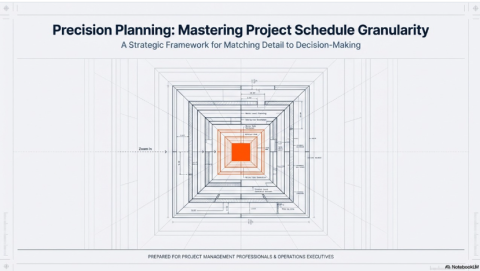
“The Right Schedule Is Not the Most Detailed One”One of the most common mistakes in planning is believing that “more detail is always better”. In reality, the right schedule is not the most detailed one, but the one that fits its purpose
1 - Start with the WBS. The schedule level of detail is never chosen randomly. It is a direct result of how detailed your WBS is. A good WBS should:
- Cover 100% of the project scope
- Be broken into Work Packages that can be: Planned, Estimated, and Measured
There is no schedule more detailed than its WBS. If your WBS is only Level 2 or 3 → your schedule will be high-level. If you have clear Work Packages → you can convert them into controllable activities
2 - The level of detail depends on the purpose of the schedule. You don’t always need a detailed schedule
- Executive / Steering Committee → Milestones
- Planning & Baseline → Work Packages → Activities
- Control & Delay Analysis → Highly detailed activities
- Portfolio Tracking → Summarized & coded schedules
Detail should match the decision level, not the planner’s personal preference
3 - Detail must match the project life cycle. A schedule should evolve over time, not be fully detailed from Day 1
- Concept / Feasibility → Very high-level
- Design Development → Medium detail
- Procurement → Package-based
- Construction → Highly detailed
- Close-out→ Milestones & punch list
As knowledge increases, detail increases
4 - Why does schedule detail really matter?
- Cost & duration accuracy
- More detail → less uncertainty
- High-level schedules → rough estimates
- Detailed schedules → accountable estimates
You cannot improve cost accuracy without improving schedule detail
Risk management
- Long activities hide risks
- Detailed activities allow: Risk linkage, Schedule Risk Analysis, and Monte Carlo simulation
- Risks are managed on activities, not milestones.
Monitoring & control (EVM / Earned Schedule)
- Large activities: Give false progress and hide real delays
- Poor granularity = misleading performance indicators
Change & delay analysis
- Detailed schedules: Show real impact of change, and Support Time Impact Analysis
- High-level schedules: Overestimate or underestimate impact
Simple decision logic. The schedule level of detail should be:
- Derived from the WBS
- Fit the decision purpose
- Match the project phase
- Be measurable and controllable
- No more, no less
Quick definition of schedule levels
Level 1 – Milestones
- Very few activities
- For senior management
- Not for control
Level 2 – Summary
- Phases & major deliverables
- Suitable for early stages & portfolio views
Level 3 – Work Package
- Directly linked to WBS
- Good for baseline & estimating
Level 4 – Detailed Control Schedule
- Short activities (10–20 days max)
- Clear logic
- Supports: EVM, Risk analysis, and Delay analysis
Golden rules to remember
- Too much detail = administrative burden
- Too little detail = loss of control
Source: Maged Moustafa, PMP®, RMP®, SP®, PBA®
BUDGETED LABOUR UNITS MISMATCH IN P6 – A PRACTICAL FIX
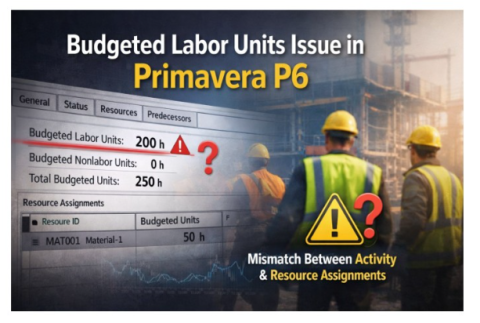
While preparing baseline programmes in Primavera P6, many planners rely on legacy programme templates from previous projects.
Although this approach saves time, it often introduces a hidden issue: budgeted labour units carried forward unintentionally from old templates.
This article explains why budgeted labour units may appear without labour resources assigned, how to identify the root cause, and a practical step-by-step method to clean the baseline programme.
If you found this useful, feel free to share or comment.
Happy planning.
Source: Hemal Shah
CONSTRUCTION CPM CONFERENCE - USA

After sixteen years of creating and conducting Construction CPM Conference, Fred has passed the torch to Josh Wollan of Zachry Construction to
Continue our Mission:
- To explore leading edge CPM scheduling concepts
- To seek out new expert schedulers and software solutions
- To boldly go where no scheduling conference has gone before
Fredric L. Plotnick, PhD, Esq, PE shall continue to provide service to our community and to those who desire projects to finish on time or even earlier or to those who wish to determine and PROVE responsibility for projects gone wrong. www.fplotnick.com 215-880-8899
CRITICAL PATH METHOD FLOAT IS GENERALLY A RED HERRING WHEN IT COMES TO SCHEDULE ASSURANCE
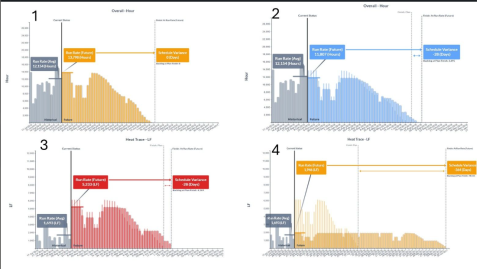
Critical Path Method float is generally a red herring when it comes to schedule assurance. What you need to look for are building bow waves based in hours, craft, quantities. You don't need float or a schedule to distribute these key progress items.
It's a simple matter of crew flows that are required to hit the key milestones. Not rocket science.
The below image #1 is the overall with a slight bow wave. When this is equalized, image #2 you can see the overall points to the project being out 28 days. However...
The true critical path is always measured in bow waves, either to your actual pace or planned pace. Image #3 clearly shows that even with the 28 day bump you would still need to *3X* or do 300% more heat trace to maintain that 28 day slip.
Flatten out the heat trace bow wave, image #4 , and you are out nearly a year. THIS is your critical path. Why would you need a schedule network to arrive at this result?
Source: Travis Arlitt
VARIANCE ANALYSIS: UNDERSTANDING ONE-WAY, TWO-WAY, AND MULTIVARIANCE METHODS | BLOG ARTICLE

Struggling to understand why your projects or budgets aren’t hitting targets?
Variance analysis helps you compare expected vs actual results and identify the root causes of deviations. Learn how one-way, two-way, and multivariance methods can improve forecasting, resource allocation, and project performance.
DECISION TRAFFIC
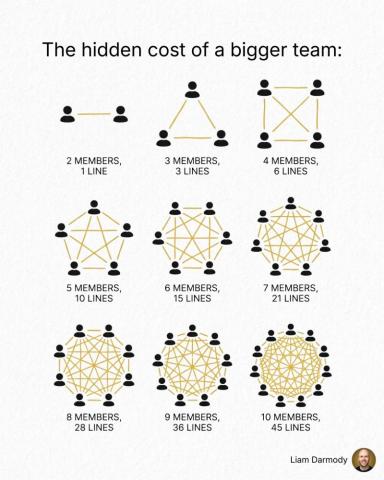
If your team feels slow after hiring, look for this: decision traffic.
In service businesses, the hire often makes total sense on paper. Then a few weeks later the team feels heavier, because decisions start taking longer.
More people get pulled into calls “just to be safe”, threads get longer, and work that used to move between two owners now waits for extra checks and sign offs.
In weekly reviews, I listen for the same signals: waiting for sign off, one more confirmation, quick sync before committing.
The math hints at why it escalates so quickly.
With 5 people you already have 10 communication lines.
With 7 it’s 21.
With 10 it’s 45.
More lines usually mean more decision paths, so fuzzy decision rights turn into calendar time fast.
So before opening a role, I run two checks:
- Which decisions will this person join, and which decisions stay tightly owned?
- What changes in ownership and decision rights on day one, so speed holds?
Sometimes hiring is still right. In other cases, clearer boundaries and two small pods with one integration point keep decision traffic low and execution predictable.
Source: Julian Alessandro Barros
HOW TO SET UP PROCUREMENT TRACKER
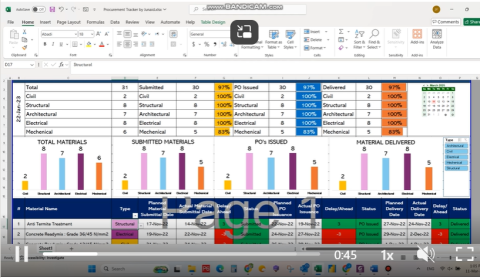
This article (with an editable template) shows how I set up a Procurement Tracker (fields can be extended based on requirements).
I just included basic fields and columns. Some features of this tracker include:
- Material type Dropdown Civil, Electrical, Mechanical etc.
- Planned Material Submission / Actual Material Submission
- In the same way Material Approval sections can be added too, I forget to add them
- Delay or Ahead in Submission and Status
- Planned PO Issuance Date / Actual PO Issuance Date
- Delay or Ahead in PO Issuance and Status
- Planned Delivery Date / Actual Delivery Date
- Delay or Ahead in Delivery and Status
- Column Chart showing Total Materials by Discipline wise
- Column Chart showing Submitted Materials by Discipline wise
- Column Chart showing PO Issued by Discipline wise
- Column Chart showing Delivered Materials by Discipline wise
- Data Bars showing progress for Submitted materials Discipline wise
- Data Bars showing progress for PO’s Discipline wise
- Data Bars showing progress for Delivered materials Discipline wise
- Mini Calendar to insert dates, Just click in the cell and Click on date in Calendar. To add mini Calendar, add an Excel add-in named as mini calendar from store.
- A Slicer to filter the Drawings by Discipline wise.
Access the Template or Read the fill post...
Source: Junaid Yaseen - RMP®/PMP®/SCE®/UPDA®/PEC®
PRIMAVERA P6 FEATURE SPOTLIGHT: ACTIVITY CODES
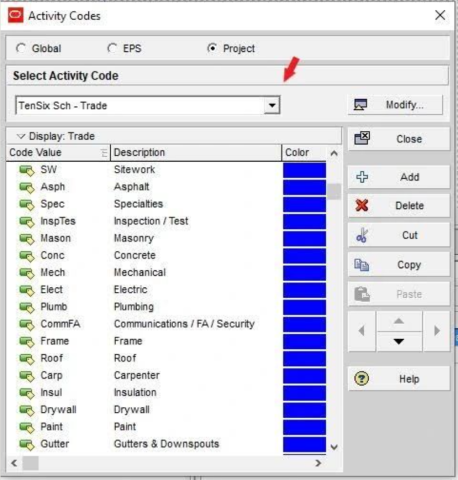
One of the most powerful—but often underused—features in Primavera P6 is Activity Codes.
At first glance, they look simple!!
In reality, they can completely change how you analyze, report, and control your schedule.
Why Activity Codes are important
- Activity Codes allow you to:
- Organize activities beyond WBS limitations
- Filter schedules quickly for specific views
- Create meaningful reports for stakeholders
- Analyze progress by area, phase, contractor, discipline, or responsibility
Instead of scrolling through thousands of activities, you can focus only on what matters.
Common practical uses
- You can use Activity Codes to:
- Separate Engineering / Procurement / Construction
- Track work by Zone or Area
- Monitor activities by Subcontractor
- Identify Critical vs Non-Critical work groups
Support dashboard reporting (Power BI, Excel, etc.)
How to use Activity Codes in P6
- Go to Enterprise → Activity Codes
- Create the required code structure
- Assign codes to activities
Use Filters, Group & Sort for instant insights
Pro tip
Well-designed Activity Codes reduce reporting time, improve decision-making, and make your schedule easier to explain to non-planners.
A good schedule is not just calculated correctly — it’s easy to understand.
Source: Abdalla Mansour
ALICE PLAN - new functionality to help view activity sequencing
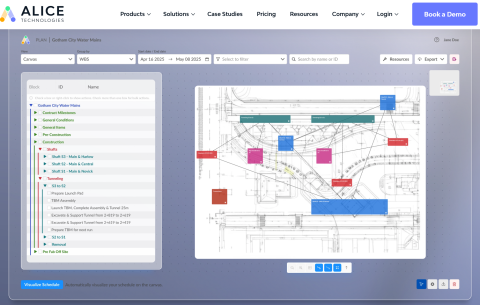
Transform your schedule into a 2D interactive layout and start planning visually—without the need for a 3D model.
FED UP WITH ADVERTS FROM SOFTWARE COMPANIES AND CONSULTANCIES THAT ARE GOING TO CHANGE THE WORLD OF PLANNING AND SOLVE ALL YOUR PROJECT PROBLEMS?
This series of occasional articles promises nothing but thought provoking questions on how well we understand the basics of our profession from the perspective of a retired planner with 50 years’ experience in the industry whose worked in a variety of UK EPC roles for Clients and Contractors with no axe to grind.
We are going to look at PEOPLE, PROCESSES, and PROCEDURES (the old 3P’s – not 4P’s, 5P’s, 6P’s or 7 P’s) that we all have been educated and trained to use in our everyday work (5W’s + 1H) and POKE THEM IN THE EYE / LOOK UNDER THE STONE (the Inverse Universe) and get into trouble with the planning profession because for loads of reasons were not doing so well.
If you want to contribute to this soul searching drop me a line with either POSITIVE or NEGATIVE comments (yes, we are PLANNERS that can hold both views at the same time!)
No 4 - Continuing with PEOPLE – Planners Self-Care and Habit Form
In blog 2 & 3 we looked at the characteristics that make a good planner and what support the project / department should provide. Now we have the right planner onboard with the right project / departmental support doing the right things he/she needs to develop his/her own personal potential, motivation, and self-worth.
The planner’s self-care
- Psychological – keep a diary, join groups, track your mood, de-clutter.
- Emotional – deep breaths, laugh with others, positive thoughts, give thanks to all, treat highs and lows with equal alacrity, be kind to yourself.
- Spiritual – meditate, forgive yourself, write out your values, spend time outside.
- Personal – set short and long term goals, plan your day / week, treat yourself, take a break from your phone / computer / video games, use technology wisely, listen to music, take all your holiday entitlement.
- Professional – read a new book, join a professional organisation or group, mentor a colleague, take breaks, record your wins.
- Physical – get 8 hours sleep, take a walk, ride a back, eat well, do exercise, play a team sport, eat regularly.
Habits a planner should develop that will last a lifetime.
- Be Proactive – You are in charge of your own career and project work.
- Have a career plan – what path do you want to follow.
- Do things in the right order – career then lifestyle.
- Think positively – only you can win.
- Listen to others – before you have your say.
- Become a team player – practice giving thanks, only the team can win.
- Take care of your physical and psychological health – a balanced work / life harmony lifestyle is best.
- Develop a “no list” – reduces unnecessary stress.
- Protect time – for what is important to you.
- Financial security – always have 3 months of savings to fall back on when the unexpected happens.
- Use technology wisely – do not let technology rule your life.
- Join a professional network.
Question to you all –
- Do you feel supported as an individual in your role?
- Are you forming work habits that will last a lifetime?
Next time, for PEOPLE No 5 , we are going to look at how the cultural environment in which you work effects the people who deliver projects with contributions from other planners.
Source: Peter Holroyd, Contact
SUPERIOR ALTERNATIVE TO THE "MOST POPULAR" SOFTWARE FOR US AS PLANNERS?

A superior alternative to the "most popular" software for us as planners?
Spider Project Team is a group of project management consulting and training companies. With headquarters in Moscow, Russia, we have branches, partners and representatives in other Russian cities, Australia, Brazil, Colombia, Kazakhstan, Romania, USA. We develop professional PM software Spider Project that is the most powerful and functional tool for project, program, and portfolio management.

We develop advanced approaches and methods of project management that are widely used by our customers in 37 countries. We provide training on project management and Spider Project software for our customers around the world.
We manage projects for our customers and implement corporate project management systems in companies of different industries. We believe that good project management can improve our world and are happy to provide the best services and tools to our customers.
We are proud of our achievements. The current version is used in 37 countries. Spider Project offers numerous unique functional features and is the only PM software that optimizes resource, cost, and material constrained schedules and budgets for projects and portfolios.
Spider Project offers numerous unique functional features and is the only PM software that optimizes resource, cost, and material constrained schedules and budgets for projects and portfolios.
Check it out here... Ask questions here...
WOULD YOU LIKE TO ADVERTISE ON PLANNING PLANET?
We want to give more of our members the opportunity to advertise on our site. Click here to get started!
THANK YOU FOR READING OUR MESSAGES
If you’d like to lend a hand to the small but enthusiastic team behind this newsletter, feel free to reach out to us at [email protected]. We know there’s still a lot of work ahead to make this an informative and eagerly anticipated bi-weekly read, so get in touch and be part of the journey.
Regards...
The Planning Planet Team