

Dear Planning Planet Members,
Welcome to the newsletter; did you know that this newsletter goes to the largest community of project controllers on planet Earth? As many of you know we’ve transitioned to a new, faster, and more modern web portal that’s already benefiting our users.
We chose to make the switch quickly rather than spend weeks testing, so we appreciate your ongoing feedback in identifying the bugs or issues we need to fix.
FREE, OPEN, COLLABORATIVE & EVOLVING - PROJECT CONTROLS GUIDELINES

The market place is full of standards, recommended practices and bodies of knowledge. We seek to provide a simple guideline(s) that would be a useful tool to everyone, from beginner to expert - easily understood.
Instead of competing with existing standards, we want to curate, simplify, and distill them into something accessible and practical for all levels of expertise. That’s powerful because it positions our guideline as a bridge between complexity and usability. Guiding Principles:
- No Reinvention: Avoid duplicating definitions.
- Distillation: Extract the essence—what practitioners actually need day‑to‑day.
- Accessibility: Use plain language and keep it simple
- Community Value: Make it free, open, collaborative, and evolving with feedback.
- Scalability: Later work could scale it from novice to expert
We have a team of senior, seasoned practitioners who are already collaborating. If you wish to get involved please email [email protected]
EARNED VALUE ONLY FAILS WHEN WE BREAK IT!
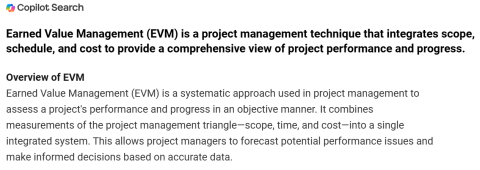
This week’s headlines across Engineering and Construction programmes have had a familiar undertone: delivery confidence, affordability pressure, and the credibility of forecasts. Whether it is programme “resets”, scope re-baselining, or renewed scrutiny from sponsors and the funding bodies , the underlying issue is not a lack of data — it is a lack of early, trusted insight.
In capital delivery projects, Earned Value (EV) is too often treated as a compliance artefact — something we produce because governance demands it, not because it helps us manage the project. When that happens, EV stops being insight and becomes noise.
Used properly, EV remains one of the few disciplines that genuinely integrates scope, schedule, and cost into a single performance narrative. More importantly, it tells us not just where we are, but where we are heading — early enough to do something about it. That forecasting capability is exactly what sponsors, boards, and assurance teams are asking for right now, and it is exactly what gets lost when EV is reduced to backward-looking variance explanations.
Across our industry this week, we have again seen the consequences of weak early warning:
- Forecasts challenged late rather than trends exposed early
- Programme confidence eroded by repeated “surprises”
- Delivery teams explaining the past instead of shaping recovery
In my experience, this comes down to a clear divide:
- Compliance-driven EV: Metrics produced late, reconciled manually, disconnected from decisions.
- Insight-driven EV: Timely, integrated data that highlights trends, exposes risk, and supports credible forecasting.
Modern capital delivery platforms reinforce this distinction. Tools such as Deltek Cobra and Contruent Enterprise (formerly ARES PRISM) show how earned value can be generated directly from integrated cost and schedule data, embedded within enterprise reporting, and trusted as a single source of truth. When EV is automated, consistent, and visible, it becomes a management tool — not a reporting burden.
For complex construction programmes typically with long durations, interdependencies, inflationary pressure, and intense funding scrutiny — that shift is no longer optional. The system needs to warn early, not explain late.
If your project reporting feels like it is defending what has already happened rather than informing what happens next, the problem probably is not Earned Value itself — it is how we are choosing to use it.
I am interested in understanding how EV applied across your programmes. Are we genuinely moving beyond compliance, or are we still leaving value on the table when we can least afford to?
Source: Andrew Langridge
iPLAN 4.0 - REDUCE RISK, DELAY, AND COST ACROSS CAPITAL PROJECTS
iPlan4.0 redefines how Shutdowns, Turnarounds, and Outages (STO’s) are delivered, providing standardised execution, full lifecycle visibility, and predictable outcomes - at every site, on every turnaround.
With AI-enhanced workflows spanning initiation, scoping, planning, readiness, scheduling, QA/QC, execution, close out, and learning, iPlan4.0 gives you full control of your shutdown cycle.
Adopt modules you need, when you need them - and scale at your own pace.
First look at iPlan4.0 AI-Enhanced Planning: WATCH VIDEO - how would this transform planning in your world?
Contact James Holt at [email protected] today to discuss your specific requirements or to arrange a full demonstration.
HOW TO BECOME AN INFLUENCER IN YOUR FIELD (INTERVIEW WITH JOHN HOLLMANN)

Watch this interview with John Hollmann for some insights on how you too can become an influencer in your field.
During this insightful interview, John talks about the difference between cost engineering and project controls, how he developed the Total Cost Management (TCM) framework, why he switched from cost engineering to quantitative risk analysis, and what made him write his book, Project Risk Quantification. In addition, he shares some great tips and insights for growing your career in project controls.
Summary of John Hollmann’s Insights on How to Become an Influencer in Your Field
Here is a summary of what it takes to become an influencer and leader in your field:
1. Be Curious and Read - If you want to understand how things work, be curious and read as much as you can. John Hollmann reads constantly. He not only reads 35 to 40 books a year, but he also reads on all of the topics that he’s studying. Reading is the foundation of everything.
2. Synthesize the Knowledge and Put It in Action - It’s not just about reading. While you study, review, and read papers, make a sense of them in your mind and synthesize all that knowledge into something practical that can be put into action.
3. Write - In order to be recognized as an expert, leader, and influencer in your field, reading and applying the knowledge learned is not enough. Eventually, you should write and talk about what you have gained. As John Hollmann points out, “You don’t need to be the expert to write a paper. You write the paper to become an expert.”
4. Take Charge of Your Own Career - Nobody is going to manage your career. Nobody’s going to educate you. Don’t expect your employer to pay for your education. It’s your job to educate yourself so you can be in charge of your career growth.
5. Leverage Your Network - Get involved and leverage the associations to the max. There’s so much opportunity. You can not only write and present but also serve as a committee chair or develop a product. You’re going to learn and meet other people along the way.
Source: Shohreh Ghorbani
IAMTECH KNOWLEDGE ARTICLE
IAMTech Knowledge: Turnaround planning often breaks down in the field. In our latest article, James Holt of IAMTech explores how to close scope, planning, safety and execution gaps with modern turnaround software.
To read the full article, click here...
Compensation Events - NEC Re-Cap
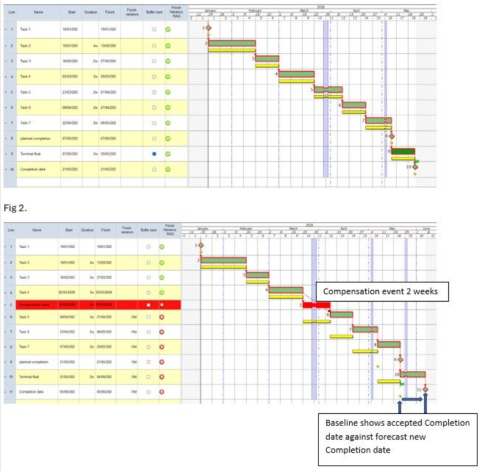
When working on an NEC contract, delays by the client are referred to as ‘Compensation events’ and should be added to the programme as they happen.
A simple way to show this is to first make sure the programme is baselined to the last accepted programme, freeze the ‘Terminal Float’ (change the ‘Terminal Float’ buffer task back into a normal task) then insert the ‘Compensation event’ as a new task linked into the project at the appropriate position.
When the project is rescheduled the added ‘Compensation event’ will then move the ‘planned completion’ and ‘Completion Date’ out by the length of the ‘Compensation event’ demonstrating the additional time required in the project versus the last accepted ‘Completion date’ as recorded on the baseline.
There we go, finding ways to clearly show compensation events and their impact upon key dates and ultimately the ‘Completion date’ is key to expediate a client acceptance.
Source: Anthony Ward
DESPITE ITS APPARENT SIMPLICITY, TOTAL FLOAT REMAINS ONE OF THE MOST MISUNDERSTOOD CONCEPTS IN SCHEDULING.
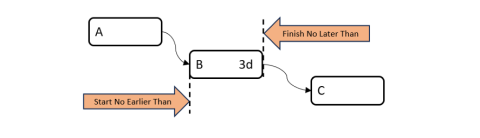
For decades, project scheduling has relied on Total Float (TF) as a core network-analysis metric -describing how long an activity can be delayed without affecting the project’s predicted completion date. Despite its apparent simplicity, TF remains one of the most misunderstood concepts in scheduling. Inconsistent definitions across software, standards, and guidelines have created ambiguity, particularly when TF appears as a negative value, contradicting its definition as a measure of allowable delay.
This paper introduces a complementary metric, Recovery Gap (RG), to clarify schedule interpretation by distinguishing forecast-driven and target-driven completion perspectives. While TF indicates how much delay is possible before impacting the forecast finish, RG quantifies deviation from specific target deadlines. A negative RG value expresses the amount of acceleration required to meet the target completion date.
Three derivative forms, Recovery Gap Start, Recovery Gap Finish, and Super Recovery Gap, provide a structured framework for evaluating how individual activities align with project objectives and deadlines.
Using practical examples, including resource-optimisation cases, this paper demonstrates how reliance on a single metric can mislead project teams, and how combining TF, RG, and related analytical metrics produces more accurate insights and more effective schedule-optimisation strategies.
Source: Alex Lyaschenko
ALICE PLAN - new functionality to help view activity sequencing
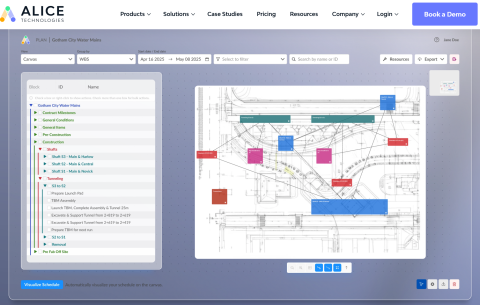
Transform your schedule into a 2D interactive layout and start planning visually—without the need for a 3D model.
A REAL PLANNERS STORY - THIS IS HOW I DID IT
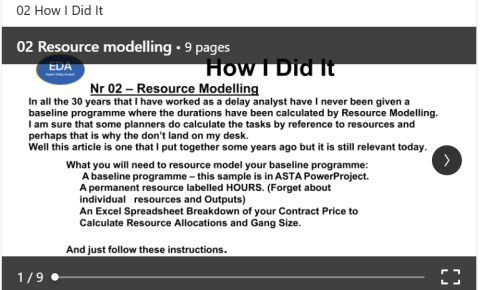
This is How I Would Do It - 02 Resource Modelling
This is the series of Articles on Planning & EOT matters
More will Follow...
Source: Mike Testro
I am now semi retired but I can offer my lifetime work and experience to the LinkedIn EOT & Quantum Claims to all Specialist Contractors and Main Contractors.
64 years of building things around the world from Hydro Electric Dams to Mrs Dinkins Basement has given me knowledge that I am happy to share.
For the last 33 years I have specialised in delay analysis. I know what is required and I know how to do it. Since 1996 I have acted as Expert Witness of Opinion in 78 Adjudications and 5 International Arbitrations.
I will provide a FREE resume the strength of your case and if I can help the I will.
WORKFLOW MANAGEMENT: HOW TO STREAMLINE PROJECT PROCESSES AND IMPROVE OVERALL EFFICIENCY | BLOG ARTICLE
Struggling with disconnected processes, manual handovers, and missed approvals?
Workflow management helps streamline project and maintenance operations by standardizing tasks, automating approvals, and providing real-time visibility across CAPEX and OPEX activities.
Learn how structured workflows reduce errors, improve efficiency, and support controlled change management
ANALOGOUS ESTIMATING: A PRACTICAL APPROACH TO PROJECT COST ESTIMATION | BLOG ARTICLE
Struggling to estimate project costs when details are still unclear?
Analogous estimating lets you generate quick, realistic early-stage cost forecasts by comparing your project to similar past projects. Learn how it works and when to use it
PLANNERS - PEOPLE - ARE YOU REALLY CUT OUT TO BE A PLANNER!

Fed up with adverts from software companies and consultancies that are going to change the world of Planning and solve all your project problems? This series of occasional articles promises nothing but thought provoking questions on how well we understand the basics of our profession from the perspective of a retired planner with 50 years’ experience in the industry whose worked in a variety of UK EPC roles for Clients and Contractors with no axe to grind.
We are going to look at PEOPLE, PROCESSES, and PROCEDURES (the old 3P’s – not 4P’s, 5P’s, 6P’s or 7 P’s) that we all have been educated and trained to use in our everyday work (5W’s + 1H) and POKE THEM IN THE EYE / LOOK UNDER THE STONE (the Inverse Universe) and get into trouble with the planning profession because for loads of reasons were not doing so well. If you want to contribute to this soul searching drop me a line with either POSITIVE or NEGATIVE comments (yes, we are PLANNERS that can hold both views at the same time!)
NO 3 - CONTINUING WITH PEOPLE – PROJECT / COMPANY PLANNING DEPARTMENT SUPPORT
- PEOPLE ARE OUR GREATEST ASSET
- PEOPLE DELIVER PROJECTS NOT SOFTWARE
In blog 2 we looked at the characteristics that make a good planner. At one time or another you will hear similar company mantras propounded. Now we have the right planner onboard we need to support him/her via the project / company department to achieve his potential or do you expect him just to get on with it without any help? So, what should the company / project offer him?
1. What the Project / Company Department should offer
Career Structure - within a defined departmental hierarchy set out in Job Descriptions based on a competency analysis (with HR).
- This should include promotion routes showing natural progression through assistant planner, planner, senior planner, planning manager, senior planning manager, head of planning, planning director,
- HR should align a company salary, benefits package, and contract of employment with the company employment structure,
- Succession planning and job satisfaction which should motivate you to do your best for the project / company.
- Company achievement awards / certificates scheme
Onboarding experience - (with HR) that introduces the way the company works.
- HR should be responsible for advertising vacancies,
- Candidates should be selected and interviewed jointly,
- Once onboard new hires should have a structured introduction to the company, planning tools and team connections,
- New hires should be inducted into IT systems and suitably badged and documented (NDA etc)
- Project introductions
Offboarding experience - for those that choose to leave.
- As a minimum a leaving interview should take place,
- HR should conduct a formal process.
Planners should be appointed - to projects.
- Clear description of your role within the project together with expectations.
Inhouse Technical Training programmes
- The department should run a series of training programmes to cover their scope of company responsibility. The development of the skills and knowledge to perform your role well is vital. 6 monthly departmental meetings/briefings can be useful.
Formal Professional Qualifications
- The department should direct and support you in obtaining qualifications from external professional bodies with fees and time off for study and exams.
Professional Development
- OPD / IPD / PDR including rotation between different projects. Yearly appraisals
Formal Approvals of Contract Documentation
- Many Companies require a formal sign off of departmental documentation (in addition to project personnel) – Tender Planning Docs, Project Planning Procedure, Baseline Schedule, Recovery Schedule, Delay Claims Reports, QA Audits, NCR Close outs etc.
2. Personal Support – the department should offer.
Access to company personnel
- Access to a Mentor,
- A list of and access to SMEs,
- Help obtaining employment inductions, cards, badges, certificates.
- Access to IT Software support,
- Access to a Group of planning experts.
- Support with HR/Employment Contract queries.
Wellbeing support – (more in blog 4)
- Access to help lines
- Time off for periods of ill health
- Mental health training
Access to Use of Standard Documentation –
- Planning manuals (corporate minimum standards, planning for non-planners, planning manual etc), library of planning docs, coding, fragnets, standard formats of planning docs, schedule reports, company coding systems, delay analysis, EVM, business software systems.
3. Department support the Company.
- Participation in company continual improvement schemes,
- Interface management with other disciplines,
- Maintenance of company databases (BMS, EPC Productivity, Vendors, coding structures),
- Software support (with IT) – Corporate systems, planning software maintenance and updating, assessment of new planning products,
- Department budgetary performance assessments,
- Work winning / marketing / tender submissions,
- Agreement of planning services on projects,
- Disciplinary measures (with HR),
- Project planning manpower estimates,
- Corporate QA audits for certification,
- QA documentation maintenance – Manuals, Procedures, Instructions, Guidance notes, Project Audit and Reviews, NC close outs, briefings,
- Company resource planning,
- Management of agency agreements,
- Departmental competency reviews,
- Department social events,
- Attendance at corporate meetings.
Question to you all –
Do you as a planner on a project feel supported in your planning role?
If you are a departmental manager, do you assess your department for competency and maturity?
Next time, for PEOPLE No 4 , we are going to look at personal self-care and lifelong habits you should form.
Source: Peter Holroyd
SUPERIOR ALTERNATIVE TO THE "MOST POPULAR" SOFTWARE FOR US AS PLANNERS?

A superior alternative to the "most popular" software for us as planners?
Spider Project Team is a group of project management consulting and training companies. With headquarters in Moscow, Russia, we have branches, partners and representatives in other Russian cities, Australia, Brazil, Colombia, Kazakhstan, Romania, USA. We develop professional PM software Spider Project that is the most powerful and functional tool for project, program, and portfolio management.

We develop advanced approaches and methods of project management that are widely used by our customers in 37 countries. We provide training on project management and Spider Project software for our customers around the world.
We manage projects for our customers and implement corporate project management systems in companies of different industries. We believe that good project management can improve our world and are happy to provide the best services and tools to our customers.
We are proud of our achievements. The current version is used in 37 countries. Spider Project offers numerous unique functional features and is the only PM software that optimizes resource, cost, and material constrained schedules and budgets for projects and portfolios.
Spider Project offers numerous unique functional features and is the only PM software that optimizes resource, cost, and material constrained schedules and budgets for projects and portfolios.
Check it out here... Ask questions here...
WOULD YOU LIKE TO ADVERTISE ON PLANNING PLANET?
We want to give more of our members the opportunity to advertise on our site. Click here to get started!
THANK YOU FOR READING OUR MESSAGES
If you’d like to lend a hand to the small but enthusiastic team behind this newsletter, feel free to reach out to us at [email protected]. We know there’s still a lot of work ahead to make this an informative and eagerly anticipated bi-weekly read, so get in touch and be part of the journey.
Regards...
The Planning Planet Team