12.0 - MANAGING FORENSIC ANALYSIS
12.1 MODULE 12-1 - INTRODUCTION TO MANAGING FORENSIC ANALYSIS
12.1.1 - WHAT IS THE PURPOSE OF MANAGING FORENSIC ANALYSIS?
The purpose of the Managing Forensic Analysis is to introduce the tools, techniques and methodologies, that have been identified as being “best tested and proven” practices from Forensic Analyses and which have been found to work on “most projects, most of the time”; provide a logical or rationale sequence showing when those tools or techniques would normally and customarily be used and in selected instances, show how to use those tools/techniques and/or where to find additional information on how to use or apply them.
In terms of the forensic analysis or claims processes, there is not any major or significant difference between how owners and contractors identify, document, process and eventually resolve claims or disputes, understanding that the major differences is one plays the role of the plaintiff and the other as defense.
Thus the purpose of this document is to establish the basis of analysis from which disputes involving the planned and actual timing and sequence of work activity impacted by elements including; Delay/impact, Disruption, Work stoppage, Mitigation measures, resulting in the prolongation of program relative to the baseline as-planned schedule and its contractually agreed milestone(s), can be analyzed, evaluated and quantified according to responsibility, entitlement, and quantum.
The strictly correct use of the adjective “forensic” refers to the application in law of scientific methods and investigation techniques. However, in recent times, we associate “forensics” to mean the results of a scientific investigation to determine factual information with a high degree of certainty which can be utilized to substantiate or refute a portrayal of events and/or non-events relevant to a dispute involving causation, effect and damages on contracted projects.
During the project, before any delays have been absorbed into the project and schedule, the best methodology for analyzing the ramifications of delays is that of the Prospective Time Impact Analysis. This technique is described in the Module 7 - Managing Planning & Scheduling, and should be used to promote contemporaneous resolution of delays.
It is important to recognize that the choice of prospective TIA or forensic analysis should be based on whether the delays have been absorbed into the project or not. When the delays have been absorbed, the analyst has the as-built conditions available to research in making a determination as to what happened. The quality of contemporaneous documents clearly makes a difference, so that is a factor in the choice of forensic analysis methodology.
If the delays have been absorbed, then this Module provides direction on how to choose and implement the appropriate methodology. So this Module is not just for claims analysis, but is often used during the project.
In the event that disputes cannot be settled by the stakeholders, the matter is then referred to a third party or parties per the dispute resolution clauses set forth in the contract documents. In the event that the contract documents are silent on the forum of dispute resolution for unsettled disputes, one of the available forums of dispute resolution may be agreed to by the involved parties or the dispute may be relegated to the applicable courts or arbitration forum to decide.
Delay and Disruption
The Business Dictionary defines:
- “Delay” to be “Unplanned deferment of a scheduled activity because of some thing or occurrence that impedes its commencement or continuation. Delay usually has time-associated cost effects on a contract which may be measured in terms of time, money, or a combination thereof”
- “Disruption” to be “In contracts, the adverse effect of a change in a contract resulting in increased cost of its performance.”
Delay is related to when an activity is performed and involves slippage of any activities start or finish dates, no matter the criticality. Critical Path delay relates to slippage or delay of any contractual milestone that extends or prolongs the contractual completion date.
The activities that contributed to the project prolongation were on initially or overtook the Critical Path and are called Critical Path driving or causal activities responsible for the delay. It is important to recognize that the driving or causal activities for delay in the schedule may be themselves driven by causes outside of the schedule, so research and care must be taken in identification of Critical Path driving or causal activities.
Disruption is related to how an activity is performed, and can occur with slippage of activities as well as without slippage. Disruption is interference in the methodical pursuit or plan for a project or activity, and can include the effects of change on unchanged work which shows in the project as resource inefficiencies.
Disruption may occur in Critical Path activities that were or were not delayed, but may also occur in Near-Critical and Non-Critical Path activities. A project that was in a delayed state, but was brought back to on-time completion may still have experienced disruption.
Disruption may be identified by specific issues, but more commonly is identified and attributed by some significant project cost overrun, such as labor costs in a specific trade.
12.1.2 - WHAT ARE THE PROCESS MAPS FOR MANAGING FORENSIC ANALYSIS?
At the 1,000 meter level of detail there are two versions showing what the process flow chart looks like to manage forensic Analysis. The first is managing claims while the project is still underway and before project completion, while the second process flow chart scenario looks at the Forensic Analysis and dispute resolution AFTER the project is completed. While the first scenario is the preferred or recommended method, more commonly we see the second scenario being implemented. These process apply equally to both the Owner and Contractor organizations, as by definition depending on the circumstances and nature of the claims/disputes, one party assumes the role of the aggrieved or damaged party and is known as the Plaintiff while the party charged with causing the damages assumes the role of the Defense.
In this level of detail, the only EXTERNAL inputs into the process become the laws, customs or standard practices of the locality where the project is being executed, which, even when we use standard contracts such as FIDIC, AIA, EJCDC, AGC or Consensus Docs, local laws, customs and practices will supersede or otherwise serve to modify those documents.
The INTERNAL inputs to Module 12- Managing Forensics come from the Contract Documents (Module 5), which, if done correctly, includes the Performance Measurement Baseline (PMB) which should have been submitted by the contractor to the owner as a pre-condition to the Notice to Proceed having been issued. The PMB is then updated based on the physical progress and of course both the contract and the PMB can and most likely will be changed as the result of any changes, whether approved or disputed.
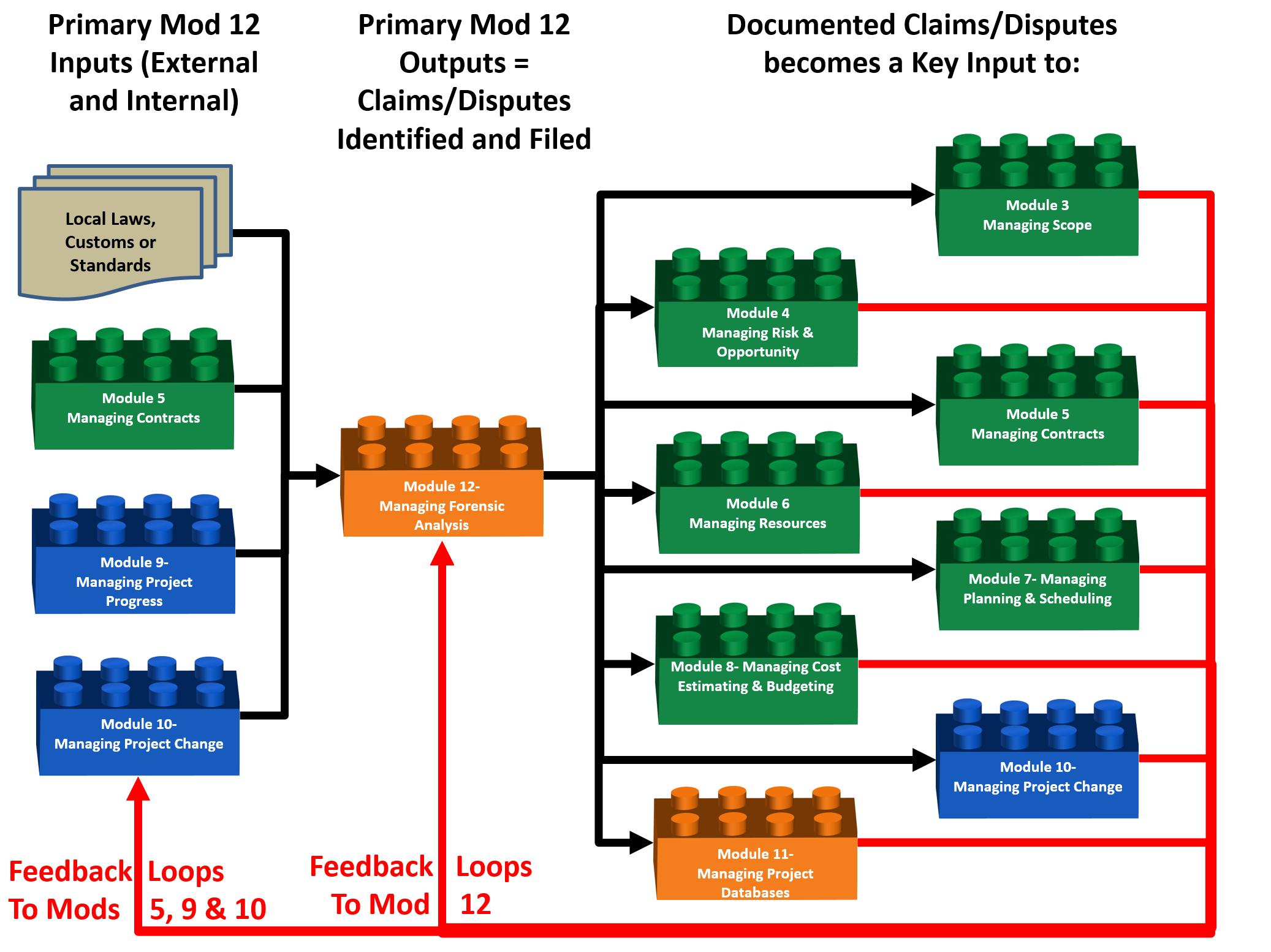
Figure 1 - 1,000 Meter Level Process Flow Chart for Module 12- Managing Forensic Analysis, from BOTH the OWNER and CONTRACTOR ORGANIZATION PERSPECTIVE PRIOR to PROJECT COMPLETION
Source: Guild of Project Controls
In the figure above, we can see that IF the Forensic Analysis (claims and dispute resolution) processes are invoked while the project is still underway, (as they should be) the outputs from this process can and most likely will have an impact on any or even all of the follow on processes. While this process may appear to be complicated and even messy, in the long run, the project, the product the project was undertaken to create, as well as all stakeholders of the project will probably be better off.
However, in the event the claims and disputes are left until after the project has been completed (as is the more common but less desirable approach) then the figure below illustrates the second process flow scenario.
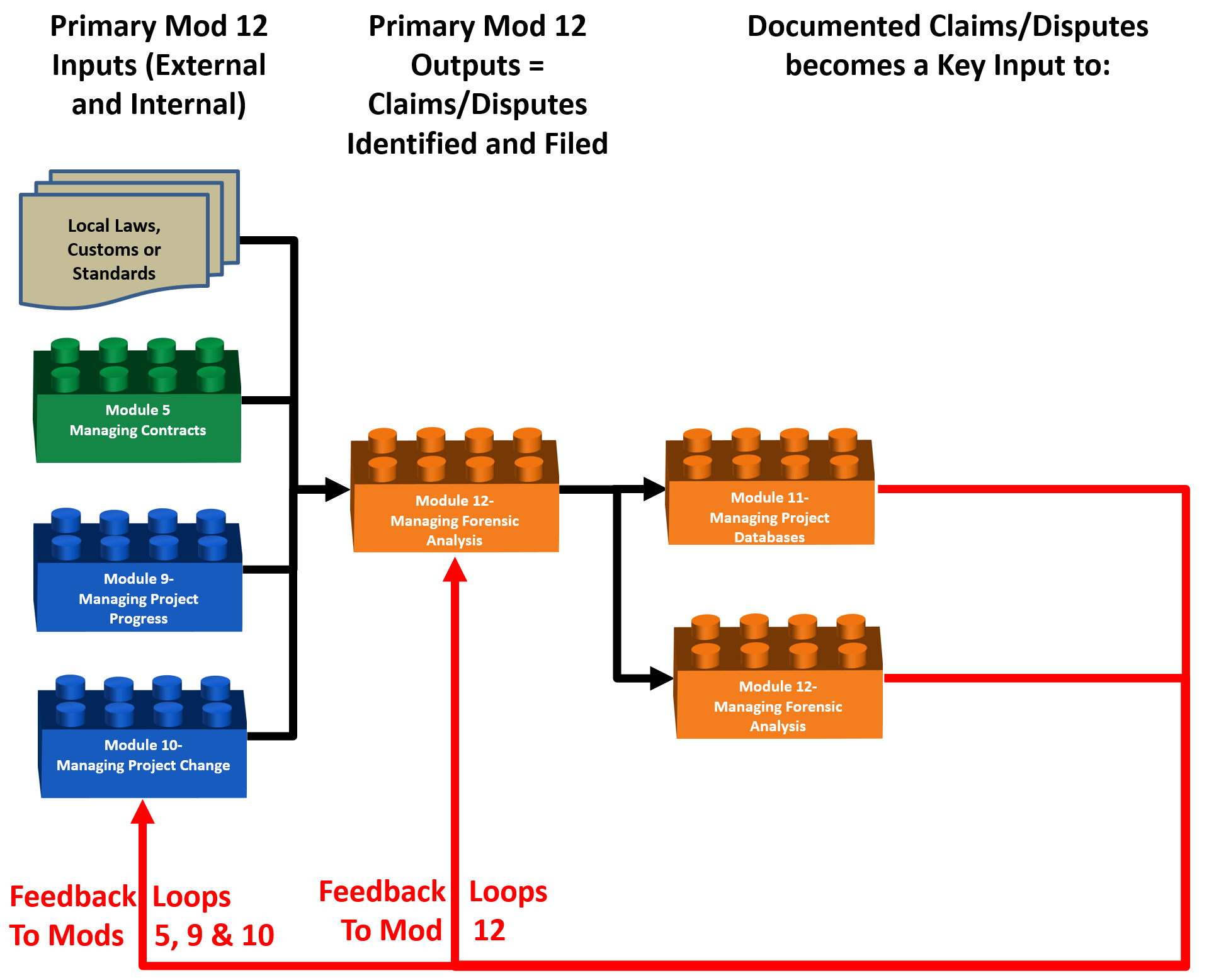
Figure 2 - 1,000 Meter Level Process Flow Chart for Module 12- Managing Forensic Analysis, from BOTH the OWNER and CONTRACTOR ORGANIZATION PERSPECTIVE AFTER PROJECT COMPLETION
Source: Guild of Project Controls
Assuming we leave all claims and disputes to after the project has been completed, as we can see from Figure XX above, we have now lost the opportunity to use the dispute resolution process for the betterment of not only the project, but the deliverables the project was undertaken to realize or achieve and all the stakeholders involved in the project.
By adopting the 2nd scenario, we now have only “winners” and “losers” and the only outcomes can be in the form of increasingly hostile, not to mention time consuming and expensive, escalating dispute resolution options and additions to the “lessons learned” database. By waiting until after the project has been completed, we have lost all opportunities to be proactively finding “win-win” solutions while the project is underway.
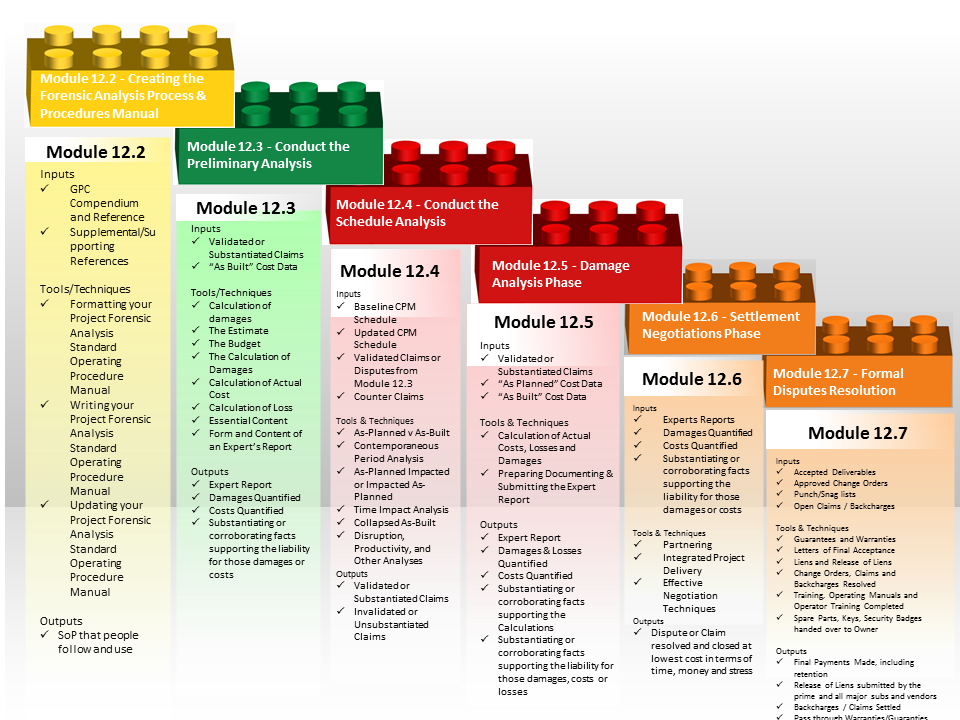
Figure 3 - 100 Meter Level Process Flow Chart for Module 12- Forensic Analyses, from both the OWNER’S and CONTRACTOR’S ORGANIZATION PERSPECTIVE
Source: Guild of Project Controls
Forensic Analyses is a six-step process - in the first step, it is important to create a policy and procedures manual for forensic analysis process that is easy to understand and to follow. Failure to do this will result in people creating their own modifications, which may or may not work the way the management needs or wants. This process provides the instructions how to INITIATE a forensic analysis and what I the process to move on to the subsequent steps.
In the second step, you should perform an analysis of the data and based on that analysis map out your claims or dispute strategies and tactics. This process functions as the planning step.
In the third step, you start to implement your plan by applying the appropriate schedule analysis tools or techniques to support the strategy and tactics identified in step 2.
In the fourth step, having established the means and methods to prove your claim (or defend against the claims made by the other side) you now have to demonstrate the damages incurred as a result of the actions or lack of actions shown in the third step.
If the parties can reach an accord, then the fifth step is to negotiate a settlement which is sufficiently satisfactory that all parties can agree to it, and if they CANNOT or WILL NOT agree, then the sixth and last step is to escalate to more formal (and adversarial and costly) dispute resolution processes.
While the 100 Meter level of detail provides a more granular look of the processes and how they interact than the 1,000 Meter view, there is yet another deeper level of detail which the Guild calls the “ground” or “working level”. It is the next level deeper which contains the explanation for each of the modules shown above, telling more about what inputs are required, including providing some examples; what tools, techniques are typically used, including providing examples or templates, and in selected instances, specific step by step instructions or links to additional resources, showing how to use each of these tools or techniques consistent with the Guild’s commitment to identify and advocate “best tested and proven” practices.
12.1.3 - BACKGROUND INFORMATION FOR MANAGING FORENSIC ANALYSIS
Background & Context to Time Related Disputes
To establish the context or basis for this module we need to first determine where we are and then where we need to be going.
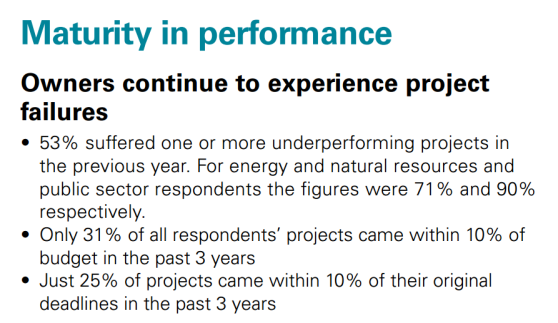
KPMG research (Figure 4 - Maturity in Performance right Source: KPMG Global Construction Survey 2015) suggests that projects are running consistently late and / or over budget.
Several researchers, most notably Glenn Butts, NASA, with his “Megaprojects Estimates- A History of Denial” , Oxford University’s Prof. Bent Flyvbjerg, with his “Quality Control and Due Diligence in Project Management: Getting Decisions Right by Taking the Outside View” and Ed Merrow, from IPA in his book “Industrial Megaprojects- Concepts, Strategies and Practices for Success” have put forward solutions to this problem, and all of them are consistent in saying that:
(1) Owners need to do a better job of scope definition as early in the project life span as possible;
(2) Owners need to be much more realistic in calculating both time and cost budgets. (Cost over-runs of 100% or more are not at all unusual)
(3) Owners need to match the type of contract with the amount and quality of scope definition. Using the wrong or inappropriate contract type for the amount of scope defined is a guaranteed recipe for disaster.
So while the KPMG and other studies are telling us that OWNERS are not happy with contractors and see areas for improvements, research indicates that the CONTRACTORS are doing also failing with alarming frequency. Research sponsored and published by the Surety Information Office (SIO) www.sio.org, National Association of Surety Bond Producers (NASBP) www.nasbp.org and the Surety & Fidelity Association of America (SFAA) www.surety.org in 2014 showed just how RISKY the contracting business is for contractors. The figure below indicates the contractor failure rates over a 3 year period between 2011 and 2013 of 20% to 29%. Assuming these numbers are typical, what that means is in any given 3 year period, between 25% to close to 30% of contactors fail. And it is highly likely that these percentages apply not only to the USA but to other countries as well.
The same research identified the root causes or “early warning” signs, many of which project control professionals can help identify and mitigate. The partial list below shows where project controls can and should be able to make a positive impact, falling under three main categories:
1. Poor Estimating and/or Job Cost Reporting:
1.1. Revenues and margins decrease over time
1.2. There are continued operating losses
1.3. The company has a loss of or reduction in bonding capacity
1.4. Company bids jobs too low
2. Ineffective Financial Management System:
2.1. Cash flow is tight or there is an inability to forecast cash flow
2.2. Receivables are turning over too slowly
2.3. Vendors demand cash on delivery for supplies and materials
2.4. Bills are past due
2.5. Company experiences profit fade
3. Poor Project Management:
3.1. Supervision is inadequate
3.2. There is an inability to administer and collect change orders
3.3. Projects are not completed on time
3.4. There is a claim on one or more contracts
3.5. Company is continually involved in litigation
3.6. Backlogs increase without adequate project management resources
3.7. Lead time to prepare bids is too short
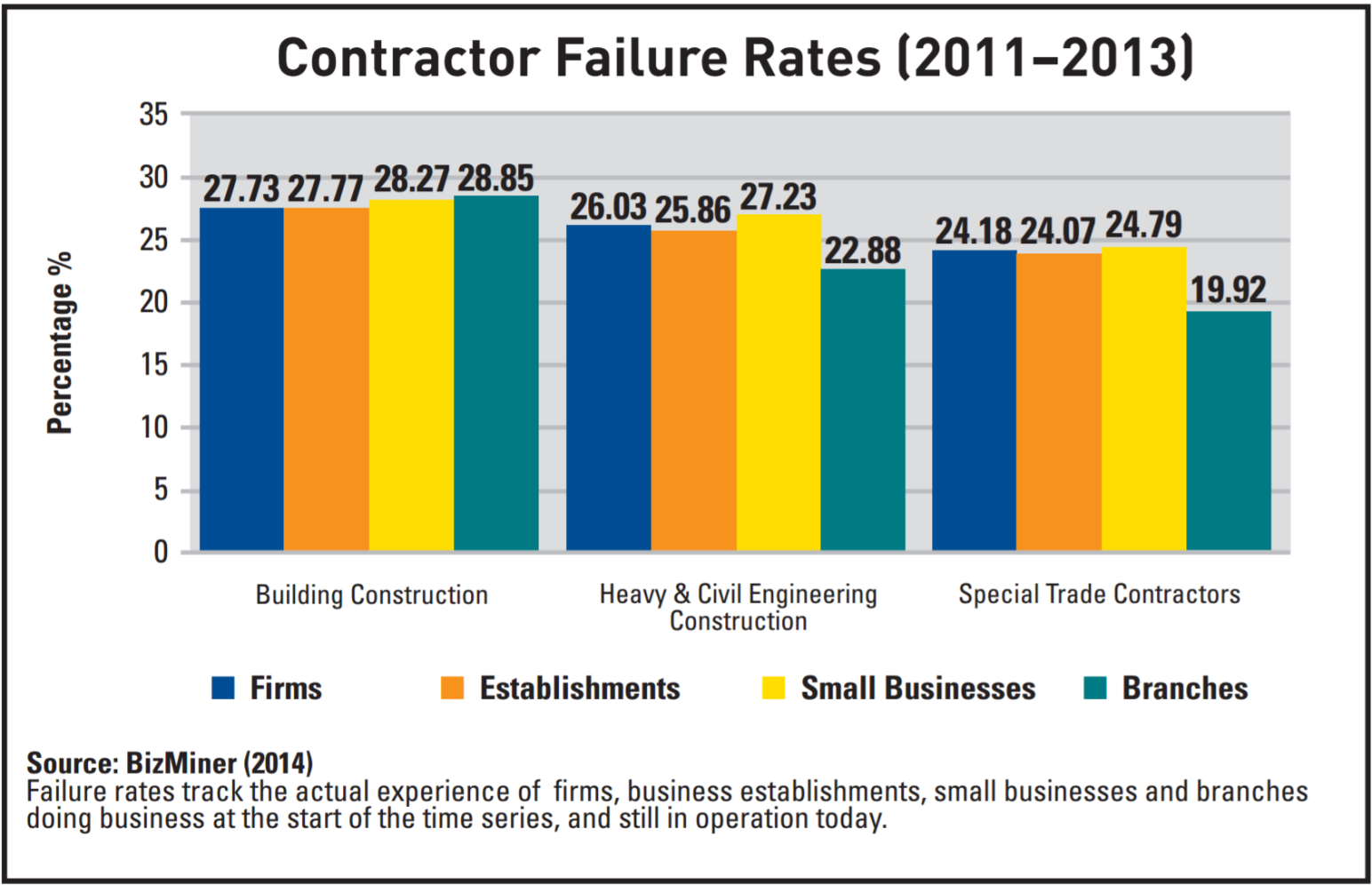
Figure 5 - Why Do Contractors Fail?
Source: Surety & Fidelity Association of America (SFAA)
Given that it was Albert Einstein who told us that “doing the same things over and over again but expecting different results is the definition of insanity”, the Guild has invested thousands of person hours to research and identify “best tested and proven” practices. At the same time, the Guild also recognizes that there are contractors and owners who do not agree with some of the practices being advocated. The question is, whether the rather poor performance recognized by both owners and contractors alike is enough for us to continue doing the same things over and over again or are we willing to at least try the “best tested and proven” practices identified by the Guild in the GPCCAR?
Recognizing that there may be more than one approach that has been “tested and proven to work”, the Guild of Project Controls has implemented a procedure (Include link to update procedure) for those who have differing opinions to share other “Best tested and proven” practices for inclusion into the GPCCAR.
This philosophy is consistent with the AIA’s “Integrated Project Delivery” (IPD) approach as shown in Module 3- Managing Scope and Module 5- Managing Contracts.
We also know from E.C Harris published research (Figure 6 - The Top 5 Leading Causes of Disputes in 2013 right Source: World Academy of Science, Engineering and Technology “Labor Productivity in the Construction Industry - Factors Influencing the Spanish Construction Labor Productivity”) that the top 5 leading causes of disputes in 2013 were:
(1) Failure to properly administer the contract;
(2) Failure to understand and/ or comply with its contractual obligations;
(3) Incomplete design information or employer requirements;
(4) Failure to make interim awards on extensions of time and compensation; and
(5) Poorly drafted or incomplete and unsubstantiated claims.
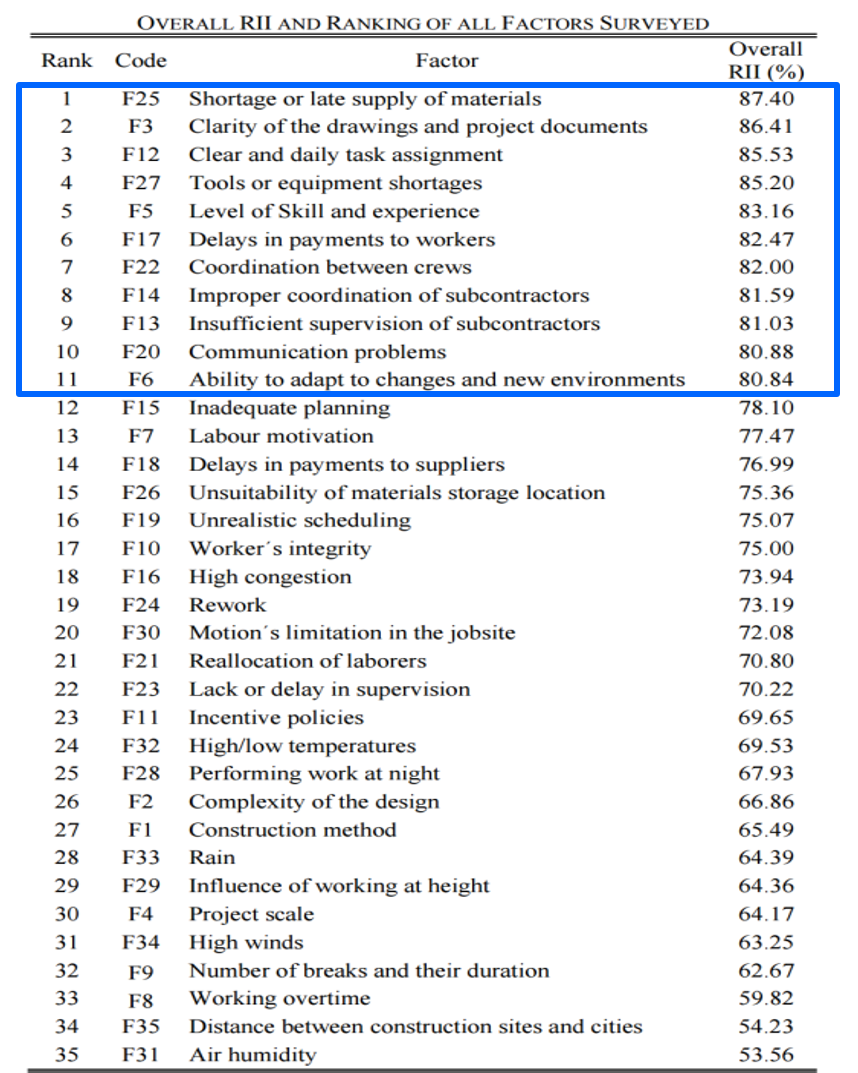
Lastly, we know from published research by the World Academy of Science, Engineering and Technology “Labor Productivity in the Construction Industry -Factors Influencing the Spanish Construction Labor Productivity” what the leading causes of reduced productivity on the project are recorded to be.
Applying the Pareto “80:20” rule we need to focus on those top 11 factors but at the same time, given the “root cause” of many claims lies with reduced or impacted productivity, we need to at least take into consideration all 35 parameters understanding that on any specific project they may be much more highly ranked.
However, this research provides a very complete and comprehensive look at all the factors likely to impact productivity and thus serves as a very handy checklist for those performing forensic analysis, particularly where productivity comes into question.
Regardless, the bottom line remains- while the probability of ever eliminating claims and disputes is probably nil, that doesn’t preclude the project control professional from being proactive in trying to identify how and why claims evolve then in our role as subject matter experts, advise our clients, project managers and senior managers how to prevent or avoid the obvious claims and conflict situations.
A construction project is defined by the sum of the contract documents. (See Module 5- Managing Contracts for more) These documents include that which is explicitly stated and that which is incorporated by reference. The project drawing plans and design/performance specifications define the nature, utility and location of the permanent components of the structure. The estimate and corresponding project budget comprise the basis for the work breakdown structure, quantity, resources and pricing of quantum for direct cost and indirect field and home office overhead costs. The content of the estimate includes means and methods, labor productivity and crewing, subcontracts, equipment, temporary materials chosen by the builder to be utilized in the construction process and the permanent materials comprising the structure as defined by the plans and specifications.
As the estimate comprises the basis of the project budget, the budget and all of its underlying assumptions with regard to productivity, means and methods, timing and sequence, resources and cost comprise the basis of the model of the CPM project baseline schedule.
A project schedule model consists of the components of the work breakdown structure, physical and preferential work activity relationships, the timing and sequence of work activity, resources and cost. The model should include submittals, procurement, construction work activity and those resources as allocated within the project budget. The major linkage between the contract estimate, budget and the baseline CPM project schedule is contained within the budgeted labor and equipment resources and the projected productivity of labor and equipment.
Over the course of the execution of the works, disputes will inevitably arise with regard to project scope and the timing and sequence of work activity. When the stakeholders to a project fail to resolve disputes involving changes to scope and detrimental impact arising from the action or inaction of another stakeholder, they look to a third independent party to render decision and resolve the dispute. The nature of a dispute inherently involves the basic factual components of detrimental cause and effect, responsibility and consequential unanticipated cost overrun (quantum). The contract mechanisms of dispute resolution during the course of the project and thereafter are typically defined within the contract documents, as is the course of action to be taken in the event that the contractual dispute resolution mechanisms fail to produce settlement of the dispute.
The purpose of this document is to establish the basis of analysis from which disputes involving the planned and actual timing and sequence of work activity impacted by elements including; Delay/impact, Disruption, Work stoppage, Mitigation measures, resulting in the prolongation of program relative to the baseline as-planned schedule and its contractually agreed milestone(s), can be analyzed, evaluated and quantified according to responsibility, entitlement, and quantum.
The strictly correct use of the adjective “forensic” refers to the application in law of scientific methods and investigation techniques. However, in recent times, we associate “forensics” to mean the results of a scientific investigation to determine factual information with a high degree of certainty which can be utilized to substantiate or refute a portrayal of events and/or non-events relevant to a dispute involving causation, effect and damages on contracted projects.
During the project, before any delays have been absorbed into the project and schedule, the best methodology for analyzing the ramifications of delays is that of the Prospective Time Impact Analysis. This technique is described in the Module 7 - Managing Planning & Scheduling, and should be used to promote contemporaneous resolution of delays.
It is important to recognize that the choice of prospective TIA or forensic analysis should be based on whether the delays have been absorbed into the project or not. When the delays have been absorbed, the analyst has the as-built conditions available to research in making a determination as to what happened. The quality of contemporaneous documents clearly makes a difference, so that is a factor in the choice of forensic analysis methodology.
- If the delays have been absorbed, then this Module provides direction on how to choose and implement the appropriate methodology. So this Module is not just for claims analysis, but is often used during the project.
In the event that disputes cannot be settled by the stakeholders, the matter is then referred to a third party or parties per the dispute resolution clauses set forth in the contract documents. In the event that the contract documents are silent on the forum of dispute resolution for unsettled disputes, one of the available forums of dispute resolution may be agreed to by the involved parties or the dispute may be relegated to the applicable courts or arbitration forum to decide.
Disruption and Productivity
While production is the measure of output, such as meters of installed pipe, productivity is the measure of the production, such as the labor hours to install those meters of pipe. Disruption generally is related to lower productivity than planned.
Productivity is usually not monitored, particularly during the production, and low productivity is often not recognized contemporaneously, so it is often calculated after the work is completed.
Excusability
Taken from the Contractor’s perspective, Excusable delay includes delays that are not caused by the Contractor and/or are beyond the Contractor’s control. Examples of Excusable delays are defective drawings, scope change, Force Majeure events, labor union strikes, differing site conditions and other unforeseen underground conflicts.
An Excusable delay generally provides entitlement to an extension of time without damages to the Contractor. It does not indicate any position with respect to payment for Contractor’s extended general conditions for the prolonged project duration.
An Inexcusable or Non-Excusable delay is one that is within the Contractor’s control and would require recovery of the lost time by the Contractor at no cost to the Owner, or would render the Contractor liable for contractual damages for late completion.
The Contractor might remove the protection against liability through unreasonable Contractor actions or inactions resulting in a failure to reasonably mitigate delays when possible.
Compensability
Again, from the Contractor’s perspective, a delay is Compensable when it is Excusable, and meets two other requirements; the delay is within the control of the Owner or Employer, and generally there is no parallel Critical Path delay on the part of the Contractor to cause concurrent delay. If there are concurrent delays, the contractual documents may have specific language to determine these issues. The contract documents should be reviewed to identify any concurrent delay, compensability, or risk shifting language.
CONTRACT & CONTRACTUAL ISSUES
Typical Contractual Notification and Mitigation Requirements
Before undertaking any form of delay/impact analysis it is important to consider what the contract requires and what it stipulates with regard to the form and forum for the resolution of requests for disputed change orders and the resolution of dispute(s) arising from causation between the stakeholders of the contract.
With the exception of contract forms such as the New Engineering Contract (NEC) suite of documents, which are very prescriptive with respect to planning and delay/impact, most commonly used forms are silent regarding the form that any analysis should take. Forms such as the Joint Contracts Tribunal (JCT) American Institute of Architects (AIA) and International Federation of Consulting Engineers (FIDIC), simply require the contractor to provide notice of impact and delay or impact, based on specified relevant events with the Owner’s Representative being required to amend the date for completion should it be considered that the relied-on events and/or non-events are likely to delay/impact this completion.
Following practical completion the Owner’s Representative then has a period to assess delay/impacts whether notified or not and to award further extensions of time if appropriate.
Upon receipt of any such notices of delay/impact the Owner’s Representative can request further details from the contractor. What this further information should consist of is not defined and it is recommended that following any such requests the contractor should ask the Owner’s Representative exactly what information is required. Under the contract the Owner’s Representative as the contract administrator will or should have attended site meetings and the like and should be well aware of the progress of the works as well as the intended sequence and timing of the forthcoming remaining works.
This being the case if the notified relevant event is relatively simple the Owner’s Representative should be able to make an assessment with little or no requirement for further information.
Delay/impacts often arise due to the late issue of information and/or late changes to the works for which the Owner is liable.
Unfortunately, due in many cases to inadequate schedule integrity; procedural non-compliances; and poor communication in control practices, what should have been straightforward claims escalate into disputes that eventually have to be referred to a third party to handle. The nature of this third party’s function usually depends on the terms and conditions of a written agreement and the result of the intervention may either be binding in law or simply advisory to facilitate the parties in reaching their own settlement.
The Contract Programme
The format that the construction program takes needs careful consideration at the time of tendering or procurement. It is all too often one of the last things considered when putting together the tender or bid documents. The failure to transfer the planning, timing and sequencing of the prosecution of the works entailed in the body of the tender or bid forward into the CPM project baseline schedule often leads to difficulties in assessing the impact that any delay/impacting event may have on the overall period for completion of the works.
Many contracts do not specify the software the use of a particular software package. The many software packages available are useful project management tools but still simply tools. And importantly, from the owners perspective, any program provided by the constructor needs to be capable of review and comment quickly to ensure that it is reasonable and suitable for the purposes intended (in most cases that will be measuring performance and alleged delay/impacts against).
Software programs that are enterprise based where the information is held in databases need particularly careful guidance protocols that should be strictly enforced as user preferences and calendars can wildly distort outputs.
Some software programs have recognized limitations which need to be considered when specifying the format of any contract or other program. The construction of the general conditions of contract, in regard to program information and format, need to be consistent and all too often this is not the case. Clever and deliberate drafting of the General Conditions can be undone simply by the format of the program (i.e. not keeping as-built records on the updated programs when the clause for EOT is based on actual delay/impacts having had an effect on the events controlling completion). The same can be said of record keeping requirements generally.
While these are project planning concerns, when a project schedule or programme must be analyzed, it must be capable of supporting the analysis. This requires certain validation protocols, review of the ability of the schedule to calculate the network reasonably, and depicts the contemporaneous plan. As a minimum though the following information should be included on any tender or contract program:
- Commencement, Access and Completion Dates of each separable portions (if any);
- Start and finish dates for each and every activity for which it anticipates it will have to perform;
- The construction or preferential logic of performing each and every activity;
- The float available;
- The contingency or time risk allowance in any activity;
- Any specific contract requirement;
- Any external constraints including design information and free issue equipment required dates.
Approval of the As-Planned or Baseline Schedule is useful in that it demonstrates a meeting of the minds for the original plan for construction. The contemporaneous documents should be reviewed to clearly understand the conditions at the time of the As-Planned Schedule submission and/or approval to ensure that any Owner-perceived deficiencies are taken into account in the schedule to be used as a benchmark for analysis. However, even if the schedule was approved, there may be problems related to missing scope or defects in the network logic that might require adjustments in order to evaluate delays.
If the project schedule was used to manage the project, it provides a better basis for analysis than if it was only submitted and then abandoned. This is true even if no approval was granted, so it is important to evaluate the quality of the schedule for the As-Planned programme as well as the updates.
Programme Revisions
Construction Contracts usually set out the circumstances when a Contract Program is allowed to be revised. Generally, when there is a significant change to the sequencing of work, the scope of work or the resource allocation, programs should be revised. This needs to be done with great care to ensure that the durations and logic, together with any user preferences and particular calendars are not also changed without agreement from the parties.
Program revisions also provide a useful record of what is likely to have actually occurred and what impact that may have had on the project duration.
Sometimes programme revisions were approved contemporaneously but just as often they were not, so it is important that the revisions are evaluated by the analyst to determine if they were reasonable and appropriate. The choices of forensic analysis methodologies offer methods that can be used in various conditions of revisions and approvals.
Variations Registers
Variation registers are a useful tool in the management of change. These need not be complicated but should as a minimum provide a unique number system for each one, provide a description, identify the method of compensation and if possible a forecast of the likely compensation (to be taken forward to the overall forecast), the progress of the variation (updated as frequently as the progress or milestone payments) whether or not the variation has been agreed (and if not it should have a link to a dispute register). Ideally the register should have a link to any correspondence that relates to the particular variation.
Contractor Instructions / Directions
Contractor Instructions and Directions do not necessarily or automatically entitle contractors to variations (despite what contractors may say). Each contract is different, but instructions and directions may not affect the contract price for the works. For example, instructions could include changes to the paint colour without changing the cost of the paint or the application time; or to test work that subsequently fails; or to perform remedial work. It is essential that the impact of each is recorded at the time issued and this included in the register along with a unique number, a description, any correspondence, progress and whether or not the instruction has been agreed (and if not it should have a link to a dispute register). It is the analyst’s role to review these documents and perform any research necessary upon which an expert opinion may be based.
Contractor Requested Directions and Request for Information (RFI)
There are occasions when the contractor is asked to perform something (often by way of an instruction) that it feels is a variation. In these cases and depending on the contract, the contractor may request a variation for the instructed works. Careful consideration of the request is needed as there can be significant implications in cost and time if the request has merit but a variation is not issued. A register of these is a useful tool which should include a unique number, a description any correspondence, progress and whether or not the scope of work has been agreed (and if not it should have a link to a dispute register). It is also useful to include an ‘actions’ column identifying whether or not advice has been taken or a commercial standpoint has been made and a risk analysis performed to identify the likely exposure to the parties.
Often the Contractor’s Request for Information will generate a response that is determined to be a variation rather than a no-cost explanation. These RFI responses should be evaluated carefully to identify any delay event causes.
Thus “forensic” schedule analysis comes into play as a means to achieve an end, that being to research, analyze and provide factual information with regard to cause and effect to be combined with expert opinion provided to a third party finder of fact to foster understanding and resolution of the dispute(s) at hand.
12.2 - Module 12-2 - Creating The Forensic Analysis Process & Procedures Manual
12.3 - Module 12-3 - Conduct The Preliminary Analysis
12.4 - Module 12-4 - Conduct The Schedule Analysis
12.5 - Module 12-5 - Damage Analysis Phase
12.6 - Module 12-6 - Settlement Negotiations Phase
12.7 - Module 12-7 - Formal Disputes Resolution
GPCCAR M12-1, Revision 1.03